
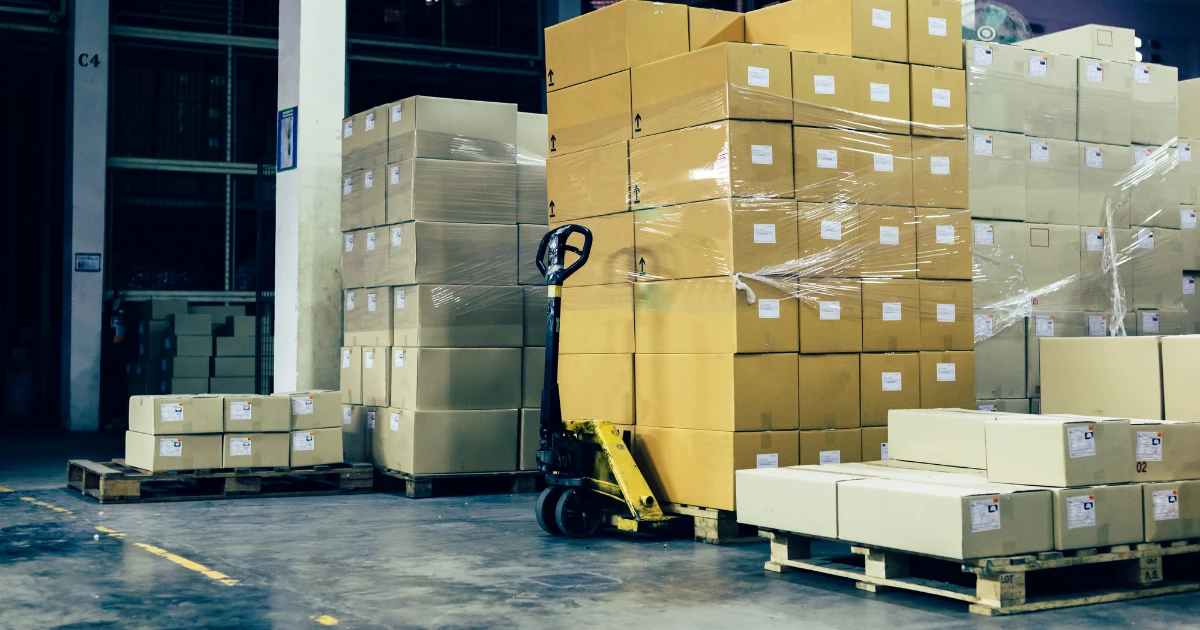
Choosing lifting equipment comes down to one question: does the load need to move, rise, or both. A pallet jack handles floor-level movement, a pallet stacker adds vertical lift for racking or stacking, and a lift table raises a load to a comfortable working height at a fixed workstation. Pick the wrong category and the equipment ends up awkward, inefficient, or simply the wrong shape for the job.
Choosing lifting equipment is easier when we start with the job rather than the product catalogue. Most warehouses and small businesses need to solve one of three problems: moving a load across the floor, raising a pallet to a higher level, or bringing a load to a comfortable working height. In this guide, we compare the three main options in practical terms, look at how each one works, where it fits best, and which questions we should ask before choosing. By the end, we should know which type of lifting equipment is most likely to solve our particular handling problem.
01
Pallet jack
Horizontal movement at floor level, over short distances
02
Pallet stacker
Horizontal movement plus vertical lift, for racking or stacking
03
Lift table
Stationary height adjustment at a fixed workstation
04
Decision factors
Load, distance, frequency and aisle space decide between them
On this page
- What's the Actual Difference Between a Pallet Jack, a Stacker, and a Lift Table?
- When a Pallet Jack Is the Right Call
- When You Need a Pallet Stacker Instead
- Pallet Jack vs Stacker: Which One Should You Choose?
- When a Lift Table Is the Answer
- Quick Decision Checklist
- Choosing the Right Equipment for Your Lifting and Moving Needs
- Frequently Asked Questions
Section 01
What's the Actual Difference Between a Pallet Jack, a Stacker, and a Lift Table?
Lifting equipment is equipment used to raise, lower, position or move loads more safely and efficiently. In a warehouse or small business, that can mean transporting a pallet from one area to another, lifting it onto a rack, or raising individual goods to a comfortable height for packing, assembly or processing.
The important point is that lifting equipment is not one universal product category with one universal job. A pallet jack is mainly intended for horizontal movement at floor level. A pallet stacker combines movement with vertical lifting, making it useful when pallets must be placed on racking or stacked. A lift table usually raises a load at a fixed workstation rather than transporting it around the facility.
When we compare lifting equipment types, we should begin with three questions: does the load need to move, rise, or both, how far does it need to travel, and how often will the task be repeated. The answers usually narrow the choice quickly.
Section 02
When a Pallet Jack Is the Right Call
A pallet jack is the right choice when we need to move palletised goods horizontally over a relatively short distance and do not need to place them at a raised height. It supports a pallet on forks, lifts it just clear of the floor and allows the operator to steer it to another location.
For straightforward loading, unloading, staging and repositioning, pallet jacks are often the simplest starting point. They are useful beside delivery vehicles, in storage areas, production spaces and dispatch zones where the main task is getting a pallet from A to B.
A pallet jack is not designed to replace a stacker when pallets must be lifted into racking, and it is not the natural choice for raising goods to a comfortable bench height for repeated picking or assembly. Its strength is controlled, low-level movement.
Manual pallet jacks suit lighter, occasional movement where the operator can comfortably pull or push the load, which can make sense for a small warehouse or shop floor with limited daily pallet traffic. Where pallets move more frequently or across longer distances, a 2 ton electric pallet jack can reduce repeated manual effort, and where the job needs a bit more lift than a standard jack offers, a 1.5 ton high-lift pallet jack is worth a look. Either still needs suitable space and operator training.
Action
If the job is floor-level movement over a short, occasional distance, a manual pallet jack is usually enough. Move up to an electric or high-lift model only once frequency, distance or lift height increase.
Allow five minutes
Section 03
When You Need a Pallet Stacker Instead
A pallet stacker is the right choice when we need to move pallets horizontally and lift them vertically to a raised position. It is designed for placing pallets on storage levels, stacking goods or positioning loads above floor level, depending on the workplace layout and equipment configuration.
Unlike a pallet jack, a stacker has a lifting mast that raises the forks and load. That makes a pallet stacker a practical option for businesses that need more vertical storage but do not require a larger industrial truck for every task.
We should choose a stacker when vertical lift is part of the job rather than an occasional afterthought. The required lift height, load size, aisle width, floor condition and frequency of use all matter, and a stacker must be stable and suitable for the intended load and storage arrangement.
A stacker may be manual, semi-electric or fully powered, depending on the model and application. Manual versions can suit lower-volume operations, while powered equipment may be more practical where pallets are lifted and moved repeatedly. The key distinction is simple: if we only need to transport a pallet at floor level, a pallet jack may be enough, if we need to put that pallet up, we should investigate a stacker.
Action
Check the required lift height, load size, aisle width and floor condition before choosing a stacker. If vertical lift isn't part of the job, a pallet jack is enough.
Allow five minutes
Section 04
Pallet Jack vs Stacker: Which One Should You Choose?
In the pallet jack vs stacker decision, choose a pallet jack for floor-level movement and choose a stacker when the load must be raised to storage or working height. The pallet jack handles horizontal travel, while the stacker combines horizontal travel with vertical lifting.
The quick test: if the operator collects a pallet, moves it across the floor and leaves it at another floor-level position, a pallet jack is usually the more direct solution. If the operator must lift the pallet into a rack, stack it above another load or position it at a higher level, a stacker is the more suitable category.
Section 05
When a Lift Table Is the Answer
A lift table is the right choice when we need to raise a load to a comfortable working height at a particular workstation, rather than move that load around the warehouse. It provides a platform that can be adjusted vertically so operators can load, inspect, assemble, pack or process goods with less bending and reaching.
Lift tables are hence different from both pallet jacks and stackers. A pallet jack is built to travel. A stacker is built to travel and lift. A lift table is usually chosen for controlled height adjustment in a fixed or semi-fixed position, beside a packing bench, production line, loading point or assembly area.
We should confirm the platform dimensions, intended load, operating height and available floor space before selecting a model. A specific option such as a 500kg lift table may suit a lighter application, while a 1000kg lift table may be the better fit for heavier loads, but the correct capacity must always be matched to the actual load and the way it will be positioned.
Action
Confirm platform dimensions, intended load, operating height and available floor space before selecting a lift table model.
Allow five minutes
Section 06
Quick Decision Checklist
Before choosing, run through a short checklist:
- Does the load need to move, rise, or both?
- How far does it need to travel, and how often will the task repeat?
- What's the available aisle width, doorway clearance, and floor condition?
- Who's operating it, and does the layout suit how they'll need to work?
The answers usually narrow the choice quickly. This practical assessment helps us choose from the available lifting equipment types with more confidence, rather than buying a product simply because it looks versatile.
Section 07
Choosing the Right Equipment for Your Lifting and Moving Needs
We can simplify the decision by matching the equipment to the movement we actually need. Choose a pallet jack when the job is mainly moving pallets at floor level. Choose a pallet stacker when pallets must be moved and lifted vertically into storage or another raised position. Choose a lift table when goods need to be raised to a practical working height at a fixed workstation.
From there, we should check the load, space, frequency of use and operator requirements. The right lifting equipment is not necessarily the largest or most powerful option. It is the one that fits our workflow safely and makes the next handling task easier.
Get these four right
- Lifting equipment is essential for safe and efficient movement, raising, or positioning of loads in warehouses and small businesses.
- Choose a pallet jack for horizontal movement at floor level, a pallet stacker for combined horizontal and vertical lifting, and a lift table for raising loads to a comfortable working height at fixed workstations.
- Assess the load, space, frequency, and workflow before selecting lifting equipment to ensure it fits the entire handling task rather than just one aspect.
- Manual pallet jacks suit lighter, occasional use, while electric models reduce operator strain during frequent or longer-distance pallet movement.
Answers
Frequently Asked Questions
What's the difference between a pallet jack and a pallet stacker?
A pallet jack moves pallets horizontally at floor level, while a pallet stacker adds vertical lift so pallets can be placed on racking or stacked higher. If the job only involves moving a pallet across the floor, a pallet jack is enough. If it needs to go up, a stacker is the better fit.
When should I choose a lift table instead of a pallet jack or stacker?
Choose a lift table when the load needs to stay in one place and be raised to a comfortable working height, not moved around the facility. Pallet jacks and stackers are built for transporting loads, while a lift table is built for stationary height adjustment at a workstation.
Can one type of lifting equipment cover all three jobs?
No single machine comfortably covers floor-level movement, vertical stacking, and stationary height adjustment at the same time. Most operations end up using more than one type across different stages of the workflow, rather than expecting one machine to do everything.
Do I need an electric or manual pallet jack for a small warehouse?
Manual pallet jacks suit lighter, occasional pallet movement over short distances. Electric models are worth considering once pallets move frequently or over longer distances, since they reduce operator strain, though they also need charging arrangements and space to accommodate.
Not sure whether you need a pallet jack, stacker or lift table?
Tell us the load, the distance, and the height you need to reach, and we will help you match it to the right equipment.