
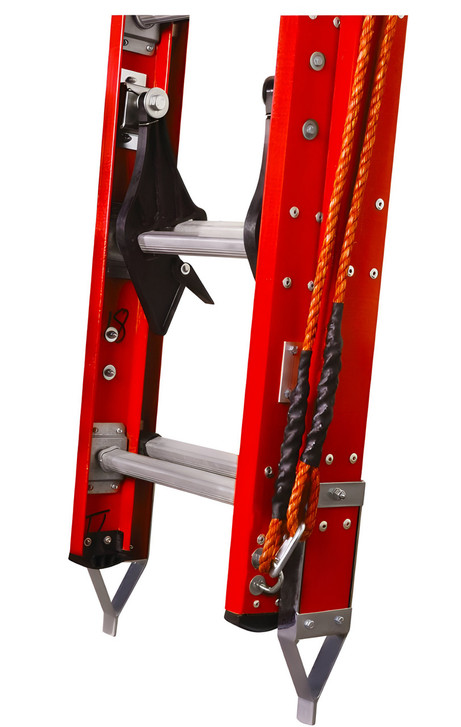
An extension ladder is used safely when it is set at a 4:1 angle, secured at the top and bottom, extended roughly a metre above the landing point, and loaded within its marked safe working load. Most ladder incidents on South African sites are not caused by faulty equipment. They are caused by a ladder that was set too steep, footed on loose ground, or asked to carry more than it was rated for. The guidance below covers what the law requires, what good practice adds, and what to check before anyone leaves the ground.
What South African law requires
Ladder use in the workplace is governed by the General Safety Regulations under the Occupational Health and Safety Act 85 of 1993. Regulation 6 sets the principle: nobody may work in an elevated position unless the work is done safely from a ladder or scaffolding, or from a position that is equally safe. Regulation 13A then sets the detail, and it is short enough that every site supervisor should know it.
Requirements for the ladder itself
Regulation 13A(1) requires every ladder to be constructed of sound material and to be suitable for the purpose it is used for. It must either be fitted with non-skid devices at the bottom ends of the stiles and hooks or similar devices at the upper ends, or it must be lashed, held or otherwise secured throughout use so that it stays stable in all conditions.
Regulation 13A(2) prohibits the use of a ladder that has rungs fastened to the stiles only by nails, screws or spikes, rungs that have not been properly let into the stiles, or stiles that are damaged and rungs that are damaged or missing. Welded, bolted and riveted rungs are the exception to the "let into the stiles" requirement. In practice this means a ladder with a cracked stile or a loose rung is not a ladder that needs watching. It is a ladder that must come out of service.
Requirements for how the ladder is used
- A ladder that leans against an object for support may not be longer than 9 m.
- The reach of a ladder may not be extended by fastening two or more ladders together, except with the approval of an inspector.
- Where work is done from a ladder, precautionary measures must be taken to prevent articles from falling, and suitable sheaths or receptacles must be provided for hand tools when they are not in use.
- Wooden ladders must be of straight grained timber, free from defects, and may not be painted or covered in a way that hides cracks. Oil, clear varnish and wood preservative are permitted.
Fixed ladders are treated separately. Regulation 13A(6) applies to a fixed ladder longer than 5 m attached to a vertical structure at 75 degrees or more. Its rungs must sit at least 150 mm clear of the structure, and it must have a cage running from a point no more than 2.5 m above the lower level to at least 900 mm above the top level served, with no part of the cage more than 700 mm from the rungs. Rest platforms spaced no more than 8 m apart may be provided instead of the cage.
Setting the angle: the 4:1 rule
For every four units of height from the ground to the point where the ladder rests, the base should stand one unit away from the wall. A ladder touching the wall at 4 m should have its feet 1 m out. That produces an inclination of roughly 75 degrees, the same angle the regulations use as the reference point for fixed ladders.
The angle matters in both directions. Set too steep, the ladder tends to tip backwards as the climber shifts weight near the top. Set too shallow, the feet slide out under load and the stiles flex. A quick field check works without a tape measure: stand with the toes against the ladder feet and extend the arms straight forward at shoulder height. If the palms rest comfortably on a rung, the angle is close to correct.
Securing top and bottom before the first step
Securing is not optional under Regulation 13A(1). A ladder must have non-skid feet and top hooks, or be tied. Tying is the more reliable of the two on most sites. Lash the stiles, not the rungs, to a fixed point at the top. Where the top cannot be tied, secure the base to a stake or a fixed anchor, or have a second person foot the ladder for the full duration of the climb.
Ground conditions do half the work. The feet need firm, level, non-slippery ground. Packing bricks, offcuts or pallets under one stile to correct for a slope is a common shortcut and a common cause of a ladder going over sideways. Where the ground slopes, use a ladder with adjustable levelling feet or move the setup.
Extending above the landing point
Where the ladder is used to access a roof, platform or upper floor, it should extend roughly a metre, or about three rungs, above the landing point. This gives the climber something to hold while stepping across, which is the moment in the sequence when most balance is lost. The regulations do not fix this distance for portable ladders, but it is settled practice and it pairs directly with the securing requirement: the projecting section is what gets tied off.
The overlap between the two sections of an extension ladder matters just as much. Follow the overlap the manufacturer marks on the ladder. Extending a two-section ladder to its full separated length so that only one or two rungs overlap removes the load path between the sections.
Reading duty ratings before the ladder goes up
Duty rating is expressed as a safe working load in kilograms, and it is a total figure. It covers the climber, their clothing and boots, any tools carried on the body or belt, and any material being taken up. A 95 kg worker carrying a 15 kg tool bag is presenting a 110 kg load, not a 95 kg one.
The extension ladders in the Dreymar Industrial range publish their safe working load on the individual product listing. The medium duty aluminium and medium duty fibreglass extension ladders are listed at 115 kg. The heavy duty aluminium extension ladder is listed at 135 kg. Where a ladder is being specified for a crew rather than an individual, specify against the heaviest realistic combined load rather than the average one.
| What counts towards the load | Frequently forgotten |
|---|---|
| Body weight of the person climbing | Winter workwear and safety boots |
| Tool belt and hand tools | Cordless tools with spare batteries |
| Materials carried up | Paint tins, cable drums, fittings |
The pre-use inspection
A pre-use check takes under two minutes and covers the failure points that Regulation 13A(2) treats as disqualifying. It should happen at the start of every shift the ladder is used on, not once a month.
- Stiles: no bends, cracks, dents or splits along either side rail.
- Rungs: all present, none loose when twisted by hand, none bent or worn smooth.
- Feet: non-skid pads present on both stiles, not worn through, not clogged with mud or paint.
- Extension mechanism: rope intact and not frayed, pulley running freely, rung locks engaging positively on both sides.
- Surfaces: free of oil, grease, mud and wet paint on rungs and stiles.
- Rivets and welds: no movement at the joints between rungs and stiles.
A ladder that fails any of these is tagged and removed from the working area the same day. Leaving a defective ladder leaning against a wall with a verbal warning attached to it is how it ends up back in use.
Climbing and working from the ladder
- Face the ladder on the way up and the way down. Maintain three points of contact throughout.
- Carry tools in a belt, a sheath or a hoist line. Regulation 13A(5) requires it, and a hand on a bucket is a hand that is not on a rung.
- Keep the belt buckle between the stiles. If the work is out of reach from that position, climb down and move the ladder.
- Do not stand on the top three rungs of an extension ladder. The stability calculation assumes the climber is below them.
- One person on a leaning ladder at a time, unless the ladder is specifically rated for more.
Aluminium and fibreglass: the electrical distinction
Aluminium conducts electricity. Where work happens near live conductors, distribution boards, overhead lines or unknown circuits, an aluminium ladder is the wrong tool regardless of how convenient its weight makes it. Fibreglass ladders are specified for that work because the stiles are non-conductive.
Outside electrical environments, aluminium ladders carry the advantage on weight, which matters when the ladder is moved repeatedly through a shift. For repetitive short-height tasks at a single position, a-frame step ladders remove the angle and securing problem altogether, since a free-standing ladder does not depend on a wall.
When a ladder is the wrong choice
A ladder is an access tool. It is a poor work platform. Where the task runs longer than about thirty minutes at height, needs both hands free, involves handling awkward or heavy items, or requires the worker to apply sideways force, the correct answer is a platform. Scaffolding or a mobile platform costs more in setup time and returns it in stability, working space and reduced fatigue.
The 9 m limit in Regulation 13A(3) is a useful marker here. Once a task needs more reach than a single leaning ladder legally provides, joining ladders together is not the workaround. Inspector approval is required for that, and a platform system is usually the faster route.
Storage and transport
Ladders are damaged in storage and transit more often than in use. Store horizontally on wall brackets at several support points, or vertically against a wall where the stiles cannot bow. Keep them out of direct sun and away from chemicals and solvents. In transit, support the ladder at multiple points along its length rather than at the two ends only, and tie it so that it cannot flex against the vehicle rack over distance.
Frequently asked questions
What angle should an extension ladder be set at?
Set the base out one unit for every four units of height to the resting point, which produces an angle of approximately 75 degrees. A ladder resting at 4 m should have its feet 1 m from the wall. Too steep risks tipping backwards, too shallow risks the feet sliding out.
How far should an extension ladder extend above the landing point?
Roughly one metre, or about three rungs, above the point being accessed. The projecting section gives the climber a handhold during the step across, which is where balance is most often lost, and it provides the section that gets tied off to secure the ladder at the top.
What is the maximum length for a leaning ladder in South Africa?
Regulation 13A(3) of the General Safety Regulations sets 9 m as the maximum length for a ladder that is required to lean against an object for support. Beyond that length, a platform system rather than a longer ladder is the compliant route to the working height.
Can two ladders be joined together to reach higher?
No. Regulation 13A(3) prohibits extending the reach of a ladder by fastening two or more ladders together, except with the approval of an inspector. This is separate from the designed extension of a single extension ladder, which operates within its own rung locks and marked overlap.
Does the safe working load include tools?
Yes. The safe working load is the total load on the ladder: the climber, their clothing and footwear, tools carried on the body, and any materials taken up. A 95 kg worker with a 15 kg tool bag presents a 110 kg load and needs a ladder rated above that figure.
Should an extension ladder be inspected before every use?
Yes. Regulation 13A(2) prohibits the use of a ladder with damaged stiles or damaged or missing rungs, so a pre-use check at the start of each shift is the practical way to meet that requirement. Any ladder failing the check is tagged and removed from service immediately.