
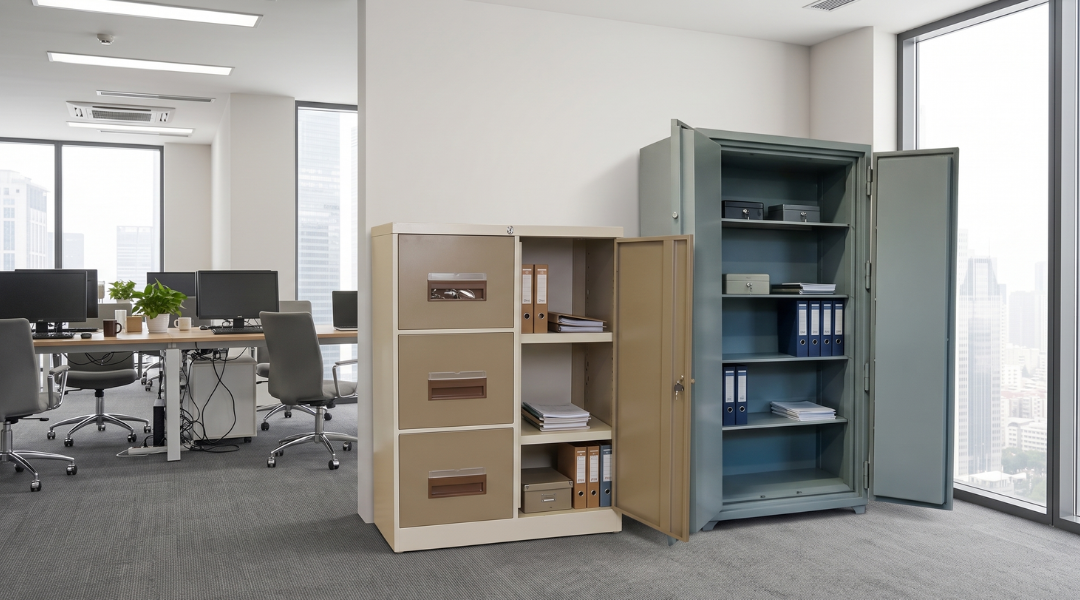
A fire resistant filing cabinet is an insulated steel cabinet designed to slow heat transfer to paper records during a fire, whereas a standard steel filing cabinet is built for daily security and durability, not thermal protection. That single distinction sits behind every decision an office manager, compliance officer or practice manager has to make when specifying storage for legal files, patient records or financial documents.
This article compares the two cabinet types using the verified dimensions of the Dreymar range, so the physical trade-off is visible in millimetres rather than marketing language. It also draws a firm line between fire resistance and fireproofing, and between theft protection and heat protection, because buyers routinely confuse them. For a broader overview of cabinet formats, the resource on office file cabinets in South Africa covers the wider category.
HEIGHT
+280 mm
1600 mm against 1320 mm on the standard unit
WIDTH
+82 mm
552 mm against 470 mm on the standard unit
DEPTH
+175 mm
805 mm against 630 mm on the standard unit
CAPACITY
No change
Four drawers either way. The extra envelope is insulation
On this page
- Fire-Resistant vs Standard Filing Cabinets: The Short Answer
- What a Standard Steel Filing Cabinet Protects Against
- What a Fire-Resistant Filing Cabinet Adds
- Side by Side: The Dimensions Compared
- The Space Trade-Off Most Buyers Miss
- Fire Resistant or Fireproof: Why the Word Matters
- Which Records Justify Fire Protection
- Security and Fire Are Different Problems
- Frequently Asked Questions
Section 01
Fire-Resistant vs Standard Filing Cabinets: The Short Answer
A standard steel filing cabinet protects your records from the things that go wrong on an ordinary Tuesday: dust, spills, curious hands and casual theft. A fire resistant filing cabinet is built to protect the same records from an extraordinary event, by slowing the rate at which heat reaches the paper inside.
Both are made of steel. Both hold suspension files. The difference is inside the walls. A fire resistant unit carries insulated construction that adds bulk to the outside without adding capacity to the inside. You pay for the envelope, not the drawer space.
That trade-off, more floor area for the same number of drawers, is the practical decision facing most buyers. The rest of this article walks through what each cabinet is designed to do, how the sizes compare in the Dreymar range, and which records realistically justify the extra footprint.
Section 02
What a Standard Steel Filing Cabinet Protects Against
A standard steel filing cabinet is built for the daily working life of an office. Powder-coated steel resists knocks, keeps dust out of paper, and stands up to the repeated opening and closing of drawers loaded with suspension files. In the Dreymar range, service life sits in the region of 10 to 20 years with maintenance in a dry environment.
Security, in this context, means deterrence. The 4 drawer steel filing cabinet with security bar uses a bar that engages the drawers, so a single lock point secures the unit against opportunistic access. That is enough for general HR files, active client folders and day-to-day administrative paperwork.
What a standard cabinet is not designed to do is slow the transfer of heat. In a fire, an uninsulated steel body conducts heat to its contents relatively quickly. The steel survives. The paper inside may not. That is the boundary between a general office filing cabinet and the fire resistant category, and it is worth being honest about before comparing dimensions.
Section 03
What a Fire-Resistant Filing Cabinet Adds
A fire resistant filing cabinet adds a thermal barrier around the drawers. The purpose is to slow the rise of temperature inside the cabinet during a fire, giving paper records a better chance of remaining legible until the fire is brought under control and the cabinet cools. It is designed to buy time, not to guarantee survival.
The Dreymar range includes a 4 drawer fire resistant filing cabinet for suspension files and a matching stationary cabinet for bound volumes and box files. Both use insulated construction, are finished in grey, and are supplied with a 12 month manufacturer's default warranty.
On ratings. No fire rating or test standard is currently published for either unit in the Dreymar fire resistant range. Sector specific requirements vary, and insurers may require a particular rated resistance period for a particular class of record. If yours does, confirm the figure and the test standard with the supplier in writing before ordering. Those decisions belong with your broker and, where relevant, a qualified fire safety professional.
Section 04
Side by Side: The Dimensions Compared
Same four drawers, different envelope. This is the trade-off a facilities manager actually faces, and it is verified from the published Dreymar specifications.
| Specification | Standard 4 Drawer (Security Bar) | Fire Resistant 4 Drawer |
|---|---|---|
| Drawers | 4 | 4 |
| Height | 1320 mm | 1600 mm |
| Width | 470 mm | 552 mm |
| Depth | 630 mm | 805 mm |
| Floor footprint | 470 x 630 mm | 552 x 805 mm |
| Protects against | Daily wear, dust, opportunistic theft | Heat transfer during a fire |
Verified against the published Dreymar product specifications.
Read the numbers plainly: the fire resistant cabinet is 82 mm wider, 175 mm deeper and 280 mm taller than the standard unit for the same four drawers. That extra envelope is the insulation. You are not buying more filing capacity. You are buying a thicker wall around the capacity you already have.
For bound records and box files, the 4 shelf fire resistant stationary cabinet sits at 1878 mm high, 961 mm wide and 671 mm deep, which is worth measuring against your available wall space before committing.
Section 05
The Space Trade-Off Most Buyers Miss
The height difference is the one people notice on the showroom floor. The depth difference is the one that catches them in the office. An extra 175 mm of depth is a meaningful intrusion into a walkway, particularly in a corridor filing area or a compact records room where an open drawer extends well beyond the body of the cabinet.
A fire resistant filing cabinet at 1600 mm tall clears most standard ceilings comfortably, but it may not clear a lower window head or a soffit.
Action
Before ordering, measure three things: the floor footprint the cabinet occupies when closed, the swing clearance in front of it when a drawer is fully extended, and the vertical clearance to any shelf, window sill or air-conditioning unit above.
Also consider weight. Dreymar rates drawer capacity at approximately 25 to 45 kg per drawer, varying by model. A fully loaded fire resistant cabinet with four drawers of dense legal files is a heavy piece of equipment on a small footprint, so the position you choose is not one you will want to change often.
Section 06
Fire Resistant or Fireproof: Why the Word Matters
Fire resistant and fireproof are used interchangeably in general conversation, and it is worth resisting the habit. Nothing storing paper in an office is fireproof in any absolute sense. A fireproof filing cabinet, in category terms, refers to the same class of product as a fire resistant filing cabinet: an insulated unit designed to delay heat transfer for a specified period under specified test conditions.
The honest description is fire resistant. The cabinet resists the effects of fire for a period. It does not render your records immune to fire. Ratings, where they exist for a given product, describe performance under a defined laboratory test, not a guarantee of outcome in your office.
That distinction matters when you are speaking to an insurer or a compliance officer. Asking for a fireproof cabinet may get you a product that does not meet the actual requirement, because the requirement is usually expressed in terms of a rated resistance period for a defined class of record. Get the terminology right and the specification conversation becomes much shorter.
Section 07
Which Records Justify Fire Protection
Not every document needs a fire resistant filing cabinet. The question to ask, folder by folder, is what happens if this record is destroyed and cannot be reconstructed from another source.
Records that typically justify the extra envelope include original signed contracts and deeds, wills and estate files, original title documents, hard-copy patient records where no digital duplicate exists, statutory registers, board minutes, and any archive a regulator or auditor may demand in original form. Requirements vary by sector, and legal, medical and financial practices each carry their own retention and protection obligations. Your compliance officer and insurer are the correct sources for the specifics.
Records that generally do not justify it include duplicates of documents held digitally, routine correspondence, day-to-day administrative paperwork and reference material. A standard steel filing cabinet handles these efficiently and at a smaller footprint. A sensible office often uses both formats side by side: fire resistant capacity reserved for irreplaceable originals, standard capacity for everything else.
Action
Walk your existing cabinets drawer by drawer and mark every folder that could not be reconstructed from a digital copy or another source. That count, not the cabinet count, is what you need to specify against.
Section 08
Security and Fire Are Different Problems
A security bar stops theft. Insulation slows heat. These are two different problems solved by two different features, and buyers routinely conflate them. A locked cabinet is not a fire resistant cabinet, and a fire resistant cabinet is not automatically a high-security cabinet.
If your risk is a walk-in theft during office hours or after, the security bar on a standard 4 drawer filing cabinet is the relevant feature. If your risk is a fire spreading from an adjacent tenancy or a ceiling void, insulation is the relevant feature. If your risk is both, you specify both, in separate units, for the records that warrant each.
The Dreymar range covers both categories. The steel filing cabinets line and the fire resistant cabinets line are supplied as distinct products, not as a single hybrid. That separation is a feature rather than a limitation. It lets you allocate the right envelope to the right record, and avoid paying for insulation on files that only need a lock.
Answers
Frequently Asked Questions
What is the difference between a fire-resistant and a standard filing cabinet?
A standard steel filing cabinet protects records from dust, daily wear and opportunistic theft. A fire resistant filing cabinet adds insulated construction designed to slow heat transfer during a fire, giving paper records more time before temperatures inside the cabinet rise. Both are steel, but the fire resistant version has a thicker envelope.
Do I need a fire-resistant filing cabinet?
It depends on what you store. If your office holds originals that cannot be reconstructed from digital copies, such as signed contracts, wills, title deeds or statutory registers, a fire resistant cabinet is worth considering. Requirements vary by sector, and your insurer or compliance officer should confirm what is expected.
How much bigger is a fire-resistant filing cabinet?
Using the verified Dreymar dimensions, the 4 drawer fire resistant filing cabinet is 82 mm wider, 175 mm deeper and 280 mm taller than the 4 drawer standard steel cabinet with security bar, for the same four drawers. The extra envelope is insulation, not additional filing capacity.
Does a fire-resistant cabinet also protect against theft?
Fire resistance and theft resistance are separate features. A fire resistant filing cabinet is designed to slow heat transfer, not to defeat forced entry. If theft is a specific concern for particular records, that requirement should be specified separately and the correct locking arrangement confirmed for the exact model.
What documents should be kept in a fire-resistant cabinet?
Records whose destruction would cause serious harm and which cannot be reconstructed elsewhere. This typically includes original contracts, deeds, wills, statutory registers, board minutes and hard-copy patient files without a digital duplicate. Routine correspondence and documents already backed up digitally generally do not justify the extra footprint.
Is a fire-resistant filing cabinet the same as fireproof?
In general use the terms are used interchangeably, and a fireproof filing cabinet usually refers to the same category as a fire resistant one. The accurate description is fire resistant, because no office cabinet renders paper immune to fire. The cabinet delays heat transfer for a period.
This article is general guidance only. Specific fire protection requirements for your sector and premises should be confirmed with your insurer and a qualified fire safety professional.
Not sure which envelope your records need?
Tell us how many drawers of irreplaceable originals you hold and the floor space you have available. We will quote the right mix of standard and fire resistant capacity rather than insulating files that only need a lock.