
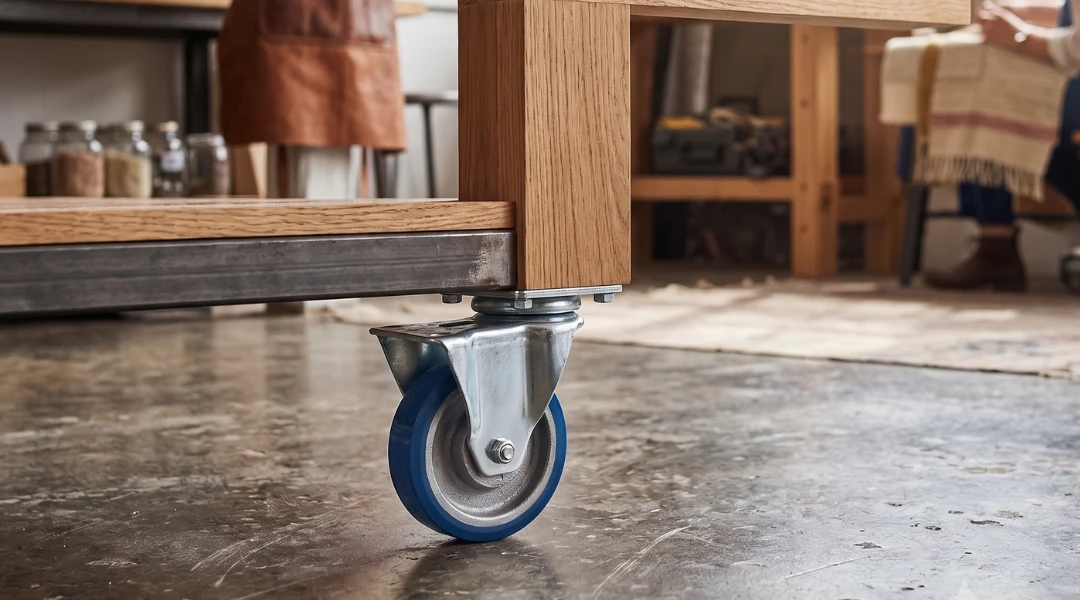
To choose castor wheels correctly, match four specifications to your application: load capacity per wheel, wheel material, swivel or fixed configuration, and mounting plate dimensions. Get any one of these wrong and the castor will fail early, usually when a bearing seizes or the tread separates from the hub.
This guide walks warehouse managers, procurement officers and factory supervisors through that selection process step by step. The specifications quoted throughout are taken from a range of industrial castors and trolley wheels stocked in South Africa, so the numbers reflect equipment you can actually order rather than generic catalogue figures.
01
Load capacity
Per wheel, calculated against dynamic load, not static
02
Wheel material
Matched to floor surface, temperature and chemical exposure
03
Configuration
Swivel, fixed or braked, set by the route the trolley runs
04
Mounting plate
Plate size, hole centres and hole diameter, measured before ordering
On this page
- Understand the Five Components of a Castor Before You Buy
- Calculate the Correct Castor Wheel Load Capacity
- Match the Wheel Material to Your Floor and Environment
- Choosing Industrial Castors for South African Warehouse Conditions
- Decide Between Swivel Castors and Fixed Castors
- Select Wheel Diameter Against Your Floor Obstacles
- Confirm Mounting Plate Dimensions and Bearing Type
- Common Specification Mistakes That Cost Money
- Final Word: Specify Once, Buy Right
- Frequently Asked Questions
Section 01
Understand the Five Components of a Castor Before You Buy
A castor is not just a wheel. It is an assembly of five load-bearing components, and each one affects service life.
- Wheel and tread: the contact surface, moulded in polyurethane, nylon, super elastic rubber, cast iron or a pneumatic tyre.
- Hub and bearing: a plain bearing, roller bearing, or precision double ball bearing for lower rolling resistance under load.
- Fork (housing): the pressed steel bracket holding the wheel axle, usually zinc plated on standard units and painted on heavy duty units.
- Swivel head: a ballrace mechanism allowing 360 degree rotation. Higher-specification units use a double ballrace.
- Top plate: the interface between the castor and your trolley chassis, defined by plate size, hole centre spacing and hole diameter.
Bearing type is the component buyers most often overlook. A plain bearing castor and a precision double ball bearing castor can carry a similar load, but the double ball bearing rolls far more easily under that load, which means a single operator can move a trolley that would otherwise need two people.
Action
Before requesting a quote, identify each of these five components on your existing castor and note which one failed first. That failure point shows where the upgrade needs to happen.
Allow ten minutes
Section 02
Calculate the Correct Castor Wheel Load Capacity
Castor wheel load capacity is the most common specification error on procurement enquiries. Buyers quote the trolley's total weight and forget that castors carry both static and dynamic loads.
- Static load: the weight carried when the trolley is stationary.
- Dynamic load: the weight carried during movement, including shock from floor joints, ramps and door thresholds.
A castor that handles its rated load in a showroom will not necessarily survive the same load rolling over expansion joints in a Johannesburg distribution centre. Specify against the dynamic figure.
The Load Capacity Formula
Use this formula for a four-castor trolley:
Required capacity per castor
(Trolley weight + Maximum load) ÷ (Number of castors − 1)
One castor is subtracted because uneven floors lift a wheel clear of the ground at any given moment. On a 1,200 kg loaded trolley with four castors: 1,200 ÷ 3 = 400 kg per castor, not 300 kg.
Add a Safety Margin of 25 to 33 Percent
Add 25 percent on top of the calculated figure for indoor warehouse work, and 33 percent for outdoor yards or ramps. On the 400 kg example above, that means specifying a castor rated at 500 kg or higher. The margin absorbs impact loading, occasional overloading by staff, and bearing wear over time.
Action
Weigh your fully loaded trolley on a pallet scale, run the formula, then add the margin. Ten minutes of calculation prevents an early replacement cycle.
Allow ten minutes
Section 03
Match the Wheel Material to Your Floor and Environment
Wheel material determines rolling resistance, floor protection, temperature tolerance and service life. On a power-floated concrete floor, which is standard in most Gauteng warehouses, the wrong tread will either mark the surface or wear out quickly.
| Material | Typical hardness | Bearing | Temperature range | Best suited to |
|---|---|---|---|---|
| Polyurethane on cast iron hub | 95 ± 3 Shore A | Precision double ball | -15°C to 80°C | General warehouse and factory floors |
| Polyurethane on nylon hub | 90 ± 5 Shore A | Double precision ball | -15°C to 80°C | Lighter trolleys needing floor protection |
| Solid nylon | 95 ± 3 Shore A | Plain or ball | -10°C to 70°C | Smooth dry floors, chemical exposure |
| Super elastic rubber (SER) | 70 ± 3 Shore A | Double precision ball | -5°C to 70°C | Fragile loads, uneven or mixed surfaces |
| Cast iron | Not applicable | Plain or double ball | -5°C to 280°C | Foundries, steel mills, high heat |
| Pneumatic tyre on steel rim | Not applicable | Double flange | Not published | Outdoor and rough ground |
Wheel material comparison across the standard industrial castor range.
For most South African warehouses the standard recommendation is polyurethane castors on a cast iron hub. The tread is wear resistant, rolls with low resistance and protects the floor surface, which means less remedial floor repair across the life of the trolley fleet.
Solid nylon is a lower-cost option and resists chemicals well, but it is a hard wheel with minimal give. On jointed or uneven concrete it transmits shock straight into the trolley chassis, which can loosen welds over time. Choose nylon for smooth, dry floors and light to medium loads only.
Where the load matters more than the wheel, super elastic rubber castors are the better answer. At 70 Shore A the tread is considerably softer than polyurethane, absorbs shock, and is non-marking, which means it suits trolleys carrying instruments, glass or finished goods across mixed surfaces.
At the other extreme, cast iron castors carry heat rather than shock. A 280°C rating puts them in foundries, steel mills and heat treatment lines, where a polymer tread would soften and deform within a shift.
Action
Photograph a one metre section of your floor and note any joints or cracks wider than 5 mm. Send that photograph with your enquiry.
Allow two minutes
Section 04
Choosing Industrial Castors for South African Warehouse Conditions
Local operating conditions change the specification more than most buyers expect. Three factors come up repeatedly across South African sites.
Coastal corrosion. Humidity and salt air in Durban and Cape Town attack standard zinc-plated housings. Stainless steel castors are available for corrosion-prone environments, including food processing and clean-room applications, which means the housing outlasts the wheel rather than the other way around.
Dust ingress. Highveld sites carry a high airborne dust load. Housings fitted with a dust-proof seal keep grit out of the swivel raceway, which means the swivel mechanism keeps turning freely instead of stiffening and forcing operators to drag the trolley sideways.
Temperature. Polyurethane stops at 80°C and nylon at 70°C. Above those figures the tread softens and deforms under load, so heat-exposed applications in the Vaal Triangle and the Germiston engineering belt need a cast iron wheel instead.
This advice is aimed at industrial and warehouse operations. It is not intended for retail display fittings or domestic furniture, where load ratings and floor requirements are entirely different.
Action
List your site's three toughest conditions (heat, wet, dust, chemicals, outdoor) and state them on the enquiry.
Allow one minute
Section 05
Decide Between Swivel Castors and Fixed Castors
The swivel castors vs fixed castors decision comes down to steering geometry rather than preference. Get the ratio wrong and operators fight the trolley all day.
- Two fixed plus two swivel: best for long straight runs in narrow aisles. Tracks straight and steers predictably from one end.
- Four swivel: best for tight manoeuvring in assembly cells and picking bays. Fit brakes on at least two positions.
- Six wheels, two fixed centrally plus four swivel corners: used on longer or heavier trolleys to spread load and reduce chassis flex.
Braked versions of the swivel castor wheels in the standard series are available across the range. A brake is not optional on any trolley that stops on a slope, at a loading bay, or in a picking aisle where it will be loaded and unloaded while stationary.
Four swivel castors suit manufacturing cells, hospital logistics and warehouse picking. They are a poor choice for trolleys pushed down steep ramps, where the trolley can turn sideways under its own momentum.
Action
Walk the trolley's route and note the tightest turn it has to make. Pick the configuration that clears it.
Allow fifteen minutes
Section 06
Select Wheel Diameter Against Your Floor Obstacles
Larger wheels roll over obstacles more easily and require less push force for the same load. They also raise the deck height of the trolley, so there is a trade-off with loading ergonomics.
Published diameters run from 40 mm on levelling castors up to 300 mm on the heaviest series. Load capacity rises with diameter within a series. On the heavy duty TH Series the polyurethane progression looks like this:
| Wheel diameter | Rated maximum load |
|---|---|
| 100 mm | 650 kg |
| 125 mm | 700 kg |
| 150 mm | 850 kg |
| 200 mm | 1,000 kg |
| 250 mm | 1,200 kg |
| 300 mm | 1,300 kg |
TH Series polyurethane load progression by wheel diameter.
That progression matters for procurement. Moving from a 150 mm to a 200 mm wheel in the same series adds 150 kg of capacity per castor, which means 600 kg across a four-castor trolley without changing the mounting plate or redrilling the chassis.
A practical rule for obstacle clearance: the wheel diameter should be several times the height of the largest obstacle on the route. If a loading bay threshold plate stands 25 mm proud, a 100 mm wheel is the working minimum and a 125 mm wheel will ride over it with less shock through the frame.
Action
Measure the largest floor obstacle on the route in millimetres and take that figure to the specification.
Allow five minutes
Section 07
Confirm Mounting Plate Dimensions and Bearing Type
Mounting decides whether a replacement castor bolts onto your existing trolley or requires the chassis to be redrilled. Mismatched top plate dimensions are a common cause of returned orders, and the measurement takes under a minute.
Top plate dimensions vary by series, not by wheel material. Two examples from a standard industrial range:
| Series | Plate size | Hole centre | Hole diameter |
|---|---|---|---|
| Medium duty (22 Series) | 104 x 80 mm | 80 x 60 mm | 8 mm |
| Heavy duty (TH Series) | 149 x 110 mm | 120 x 80 mm | 12 mm |
Top plate dimensions by series.
Note that the heavy duty plate carries the same dimensions across every wheel diameter from 100 mm to 300 mm. That means a fleet standardised on one plate size can move up or down the load range without any chassis modification, which is a significant saving when upgrading an existing trolley fleet rather than buying new.
Bearing selection follows the duty cycle:
- Plain bearing: lowest cost, suited to occasional movement and lighter loads.
- Roller bearing: handles heavy static loads well with moderate rolling ease.
- Precision double ball bearing: lowest rolling resistance, specified for daily-use industrial trolleys and heavy duty series.
For any trolley moved multiple times a day, specify a precision double ball bearing in the wheel and a double ballrace in the swivel head, which means the swivel keeps turning freely rather than binding and forcing operators to shove the trolley round corners.
Note that scaffold castors are a separate case. They mount on a stem rather than a plate and are fitted with kick-lock and thumb-brake mechanisms, so the measurement needed is stem diameter and length rather than plate size.
Action
Remove one existing castor, measure the plate, the hole centre spacing and the hole diameter, then photograph the assembly and send it with the enquiry. Five minutes of measurement prevents a wasted delivery.
Allow five minutes
Section 08
Common Specification Mistakes That Cost Money
Four errors account for most premature castor failures.
- Specifying to static load. The rating on the product page is a maximum. Real dynamic loading over joints and ramps is harsher.
- Ignoring floor surface. A hard wheel on jointed concrete transfers every impact into the chassis and the operator's wrists.
- Buying on unit price alone. A plain bearing castor is cheaper on the invoice and more expensive in labour, because loads that one person could move now need two.
- Not measuring the existing plate. This is the single most avoidable error, and it turns a same-week fix into a return and a reorder.
Sealed precision double ball bearing units across the full heavy duty trolley wheels range are grouped by series and load rating, so matching a replacement to an existing top plate comes down to one measurement.
Action
Audit one trolley today against all four points above. Twenty minutes, and it will tell you whether the rest of the fleet has the same problem.
Allow twenty minutes
Section 09
Final Word: Specify Once, Buy Right
Choosing castor wheels is an engineering decision, not a shopping decision. Calculate the dynamic load per wheel, match the tread to your floor, pick the configuration that fits your route, and confirm the mounting plate before you order.
Get these three right
- Polyurethane on power-floated concrete for most South African warehouse operations.
- Sealed bearings and dust-proof housings on dusty or coastal sites.
- A safety margin of at least 25 percent on every load calculation.
Get those three right and the castors will outlast the trolleys they carry.
Answers
Frequently Asked Questions
How do I calculate castor load capacity?
Divide the total trolley weight plus maximum load by the number of castors minus one, then add a safety margin of 25 percent. For a 1,200 kg loaded trolley on four castors, that is 1,200 divided by 3, giving 400 kg, plus 25 percent, so specify 500 kg per castor.
What is the difference between swivel and fixed castors?
Swivel castors rotate 360 degrees on a ballrace mechanism for manoeuvrability. Fixed castors roll in one direction only, giving straight-line tracking. Most industrial trolleys combine two of each: fixed at one end for direction control, swivel at the other for steering.
Which castor wheel material is best for concrete floors?
Polyurethane on a cast iron hub, rated around 95 Shore A, performs best on power-floated concrete. It is wear resistant, rolls with low resistance, protects the floor from marking, and is available with precision double ball bearings for daily industrial use.
How many castors should a trolley have?
Most trolleys use four castors: two fixed and two swivel, or four swivel where tight manoeuvring matters. Longer or heavier trolleys benefit from six wheels, with two fixed centrally and four swivel at the corners, to spread load and reduce chassis flex.
Do heavy duty trolley wheels need brakes?
Yes, wherever the trolley stops on a slope, at a loading bay, or in a picking aisle. Fit brake castors on at least two positions, diagonally opposite. Swivel brake versions are available across the standard industrial series alongside fixed and swivel-only options.
What temperature can industrial castors handle?
It depends on the wheel material. Polyurethane runs from -15°C to 80°C and nylon from -10°C to 70°C. Cast iron wheels handle up to 280°C, which makes them the correct specification for foundries, steel mills and other high-temperature industrial environments.
Not sure which castor your application needs?
Send us the loaded trolley weight, a photograph of your floor, and the top plate measurements. We will specify against the dynamic load and confirm the plate fits before anything ships.