
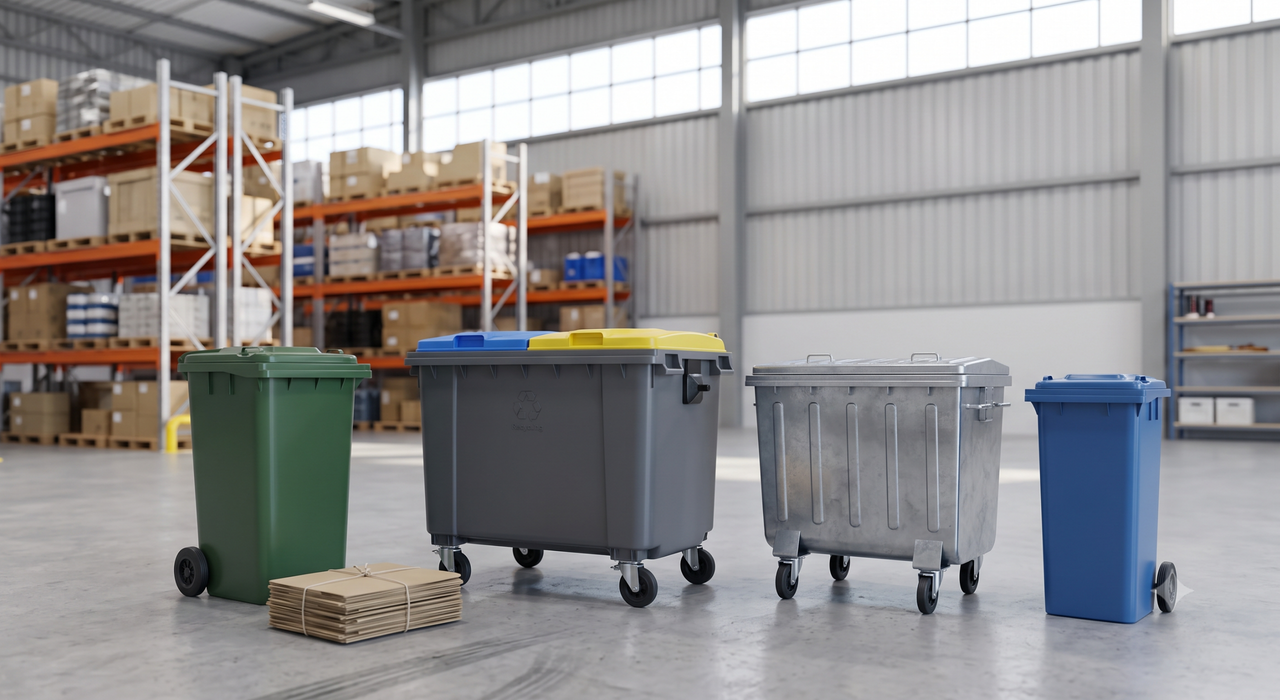
Picking the right wheelie bin sounds simple until you're standing in a yard trying to work out whether a 240L will handle a week's worth of waste, or whether you should size up to a 660L for the whole complex. Get it wrong and you're either paying for space you don't use, or you're wrestling with overflow every collection day.
At Dreymar Industrial, we supply wheelie bins across South Africa for households, complexes, schools, factories, and municipal contractors. This 2026 guide breaks down the wheelie bin sizes you'll actually see on the local market, 120L, 240L, 660L, and 1100L, with practical detail on dimensions, capacity in refuse bags, and where each size fits best. We'll also cover the SA municipal standard, SABS considerations, and how to choose the size that matches your waste volume without overspending.
Key takeaways
- The 240L wheelie bin is South Africa's municipal standard and the most common choice for residential and small business use, compatible with all major city collection trucks.
- Wheelie bin sizes range from 120L to 1100L, with choice depending on weekly waste volume, collection frequency, and available space. Work through five key questions to avoid overpaying or dealing with overflow.
- Commercial sites and complexes typically require 660L or 1100L bins due to higher daily waste volume, while households with gardens often benefit from two 240L bins for separate waste streams.
- UV-stabilised HDPE, SABS approval, quality wheels, and municipal compatibility matter more than price. A durable bin lasting 8 to 10 years costs less than replacing a cheap one that cracks in 18 months.
- Monthly rinsing, shaded storage, and annual axle maintenance are simple habits that significantly extend a bin's lifespan and prevent odour and pest problems.
What is a wheelie bin and why size matters
A wheelie bin is a mobile waste container made from heavy-duty plastic (usually UV-stabilised HDPE), fitted with two or four wheels and a hinged lid. The design is straightforward, a rectangular body, a comfortable handle, and wheels that let one person move a heavy load without lifting it. In South Africa, wheelie bins are the standard container for kerbside collection, complex refuse rooms, and industrial waste points.
Size matters more than most buyers realise. Choose too small and you'll deal with overflow, extra bag purchases, and unhappy tenants. Go too big and you're paying for capacity you don't use, plus a full bin can become genuinely difficult to move. The right size sits comfortably between your weekly waste volume and how often it gets emptied. That balance is what this guide helps you work out.
The Dreymar wheelie bin range covers the four sizes that dominate the SA market, each engineered for local climate conditions and municipal lifting mechanisms.
Standard wheelie bin sizes explained
South African wheelie bins come in four main sizes: 120L, 240L, 660L, and 1100L. Here's a quick comparison before we go into the detail.
| Size | Best for | Approx. refuse bags | Typical use |
|---|---|---|---|
| 120L | Small households, offices | 2-3 | Domestic, light commercial |
| 240L | Standard homes, small business | 4-5 | SA municipal standard |
| 660L | Complexes, schools, retail | 11-13 | Commercial, shared waste points |
| 1100L | Factories, industrial sites | 18-20 | Industrial, high-volume waste |
Each size has a clear role. Below we cover the two most-asked-about sizes in more depth.
240 litre wheelie bin dimensions and common uses
The 240 litre wheelie bin is the workhorse of South African waste collection. The standard 240 litre wheelie bin dimensions sit at around 1000mm high, 720mm long, and 580mm wide, with a weight near 10.5kg when empty and two 200mm rubber wheels at the back [CONFIRM SPEC]. It holds roughly 4 to 5 standard black refuse bags, enough for a family of four or a small business over a normal collection cycle.
You'll find the 240L outside most suburban homes, at small guesthouses, offices, restaurants, and clinics. It's compatible with the lifting mechanisms fitted to municipal refuse trucks across the country, which is a large part of why it's become the default.
Smaller and larger options: 120L, 660L, and 1100L bins
Outside the standard 240L, the SA market also runs a 120L bin for compact spaces, and larger 660L and 1100L bins for shared or industrial use. You'll occasionally see 140L, 360L, and 770L bins referenced too, these are less common locally and are usually specified for particular contracts or imported to match legacy fleets. For most South African buyers, the choice sits squarely between the 120L, 240L, 660L, and 1100L options.
The standard wheelie bin size in South Africa
If you take one thing from this guide, take this: the standard wheelie bin size in South Africa is 240 litres. The municipal wheelie bin size in South Africa is that same 240L unit. It's the size Johannesburg, Cape Town, Ekurhuleni, Tshwane, eThekwini, and most other metros collect from kerbside. Refuse truck lifters are calibrated for it, and replacement or additional units are readily available.
Why does this matter? Because you can't just buy any bin off the shelf and expect the truck to lift it. If the rim profile or handle position doesn't match the lifter, the crew will leave it. That's why the standard wheelie bin size in South Africa has settled on 240L with a specific rim design, rather than the 140L or 180L bins that dominate in the UK.
A quick note on quality: the SA benchmark is SABS approval and UV-stabilised HDPE, not the European EN840 standard you'll see on imported spec sheets. We'll come back to that further down. If you're replacing a bin the municipality collects, a 240L is almost always the right call.
How to choose the right wheelie bin size for your needs
There's no single “best” size, the right bin depends on your waste volume, your collection schedule, and who has to move it. Work through these five questions and you'll land on the correct size almost every time:
- How much waste do you generate per week? Count bags honestly. A family of four typically fills 3 to 4 bags, a small office fills 1 to 2.
- How often is it collected? Weekly collections favour smaller bins. If pickup is every two weeks, size up.
- Where will it live? A 1100L needs proper clearance and a flat surface. Measure the space before you buy.
- Who moves it? A full 1100L can weigh over 400kg. If one person handles it, a 660L may be smarter.
- Do you separate waste? Recycling and general waste in separate 240L bins often works better than one huge mixed container.
Residential vs commercial requirements
For a standard home, a single 240L bin handles most weekly waste comfortably. Households with gardens or larger families sometimes add a second 240L for garden refuse.
Commercial sites are a different picture. Restaurants, retail back-of-house, and schools usually need at least a 660L, sometimes two, because their waste is bulky and generated daily. Factories, warehouses, and event venues generally step up to the 1100L, which cuts collection frequency and keeps the yard tidy. Complexes tend to mix, a bank of 660L bins in a shared refuse room works well for medium developments, while larger estates specify 1100L units.
Wheelie bin prices and what to check before you buy
Wheelie bin prices in South Africa vary with size, material grade, and order volume. As a rough guide, expect 120L and 240L bins to sit at the lower end, 660L in the middle, and 1100L bins at the top. Bulk orders for municipalities, complexes, and industrial clients typically attract better per-unit pricing, and custom branding or colour-coding can be added for waste-separation programmes.
When comparing wheelie bins for sale, check a few things beyond the sticker price:
- Material: UV-stabilised HDPE is essential for SA sun exposure. Cheaper polypropylene bins crack within a season or two.
- Wheels and axles: Rubber wheels with steel axles outlast the moulded plastic versions on heavy loads.
- Lid fit: A snug lid keeps pests out and smells in.
- Municipal compatibility: Confirm the rim profile matches your local truck lifter.
- After-sale support: Replacement wheels, axles, and lids should be available without buying a whole new bin.
A full waste and storage setup often runs beyond bins alone. Alongside the wheelie bin range, plastic containers handle bulk material, tote bins suit stackable parts storage, and shelf bins keep small components sorted at the picking face, all from one supplier.
Care, maintenance, and longevity tips
A good wheelie bin should last 8 to 10 years, sometimes longer. A few simple habits stretch that considerably:
- Rinse it out monthly. A hose, a squirt of dish soap, and a stiff broom is all it takes. This stops odour build-up and keeps flies away.
- Keep it out of direct sun where possible. Even UV-stabilised HDPE fades faster in full afternoon sun. A shaded corner extends the plastic's life.
- Don't overload it. Cramming a 240L past its rim strains the hinges and can crack the lid.
- Bag sharp waste. Broken glass, metal offcuts, and garden thorns can gouge the inner wall. Bag them first.
- Check the wheels and axle annually. A quick shot of grease on the axle keeps rolling smooth. Replace worn wheels before they seize, a dragging bin is what usually cracks the base.
- Watch the lid pin. The lid pivot is the most common failure point. If it starts squeaking, a drop of oil or a replacement pin is a cheap fix.
For commercial sites, we recommend a quarterly deep clean and a documented inspection. Catching a hairline crack early is far cheaper than replacing a whole bin.
Need wheelie bins for your business?
Dreymar supplies 120L, 240L, 660L and 1100L wheelie bins across South Africa, with bulk pricing, SABS-aligned build quality and nationwide delivery.
View the wheelie bin range »Conclusion
Choosing the right wheelie bin size comes down to matching capacity to your actual waste output, your collection schedule, and the space you've got. For most South African homes, the 240L is the obvious answer, it's the municipal standard, it fits the truck lifter, and it handles a normal week's waste. Businesses and complexes usually step up to 660L or 1100L depending on volume.
Whatever your setup, buy on quality, UV-stabilised HDPE, SABS-aligned build, and solid wheels, not just price. A cheap bin that cracks in 18 months costs more than a proper one that lasts a decade. The full Dreymar wheelie bin range covers every size in this guide, and our team can size an order or quote a bulk requirement.
Frequently asked questions
How many refuse bags fit in a 240L wheelie bin?
A 240 litre wheelie bin holds roughly four to five standard black refuse bags. That is typically enough for a family of four over a normal weekly collection cycle, or for a small office or shop generating moderate daily waste.
What is the standard wheelie bin size in South Africa?
The 240 litre bin is the standard municipal size across South Africa. It is the size most metros collect kerbside, and refuse truck lifting mechanisms are calibrated for its rim profile, which is why it has become the default choice.
What are the dimensions of a 240 litre wheelie bin?
A typical 240 litre wheelie bin measures around 1000mm high, 720mm long and 580mm wide, and weighs about 10.5kg empty. It runs on two 200mm rubber wheels. Dimensions vary slightly between manufacturers [CONFIRM SPEC].
Can one person move a full 1100L wheelie bin?
A full 1100 litre bin can exceed 400kg, which is difficult and unsafe for one person to move on anything but a flat, smooth surface. Where a single operator handles the bin, two 660L units are usually the safer choice.
Is one large wheelie bin better than two smaller ones?
Not always. Two 240L bins allow waste separation, are easier to move, and fit through narrower access ways. A single larger bin reduces collection frequency but concentrates weight, so the right answer depends on who moves it and whether you separate waste.