
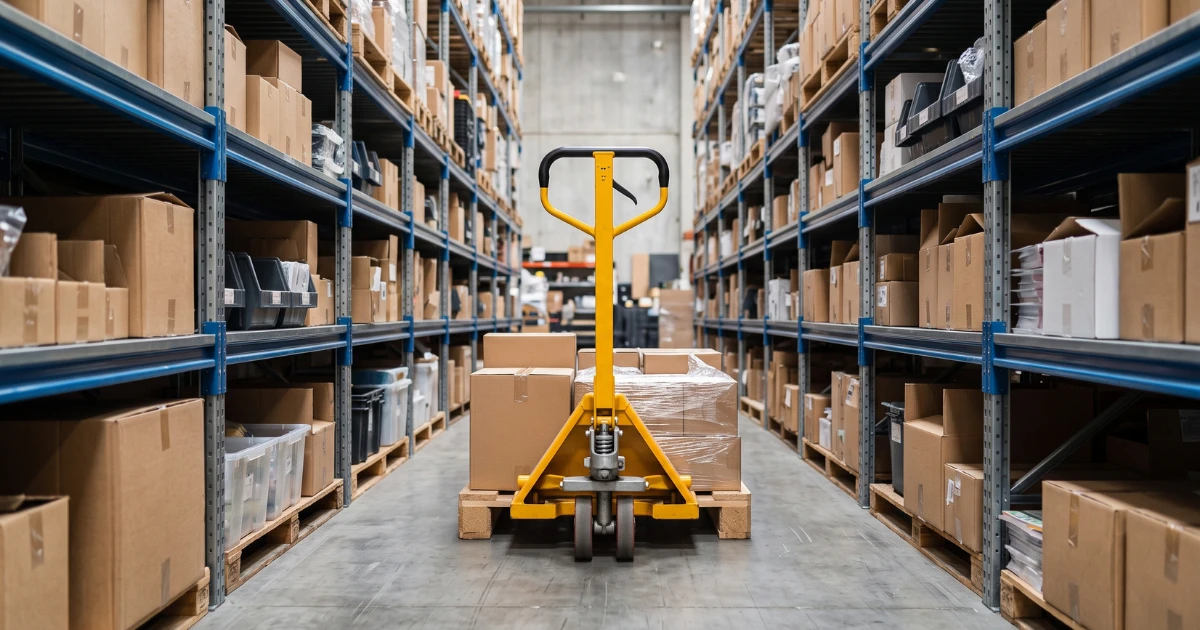
For a small warehouse, the aisle width and turning radius decide the pallet jack, not the load capacity. Measure the tightest gap and turn the jack must clear before comparing any model, then rule out the specialised variants, high-lift, stainless, and scale, that most small operations do not actually need. What is usually left is a narrow, compact, low profile or manual jack sized correctly for the floor.
Choosing a pallet jack for a small warehouse is not simply a matter of picking the highest load capacity or the lowest price. When floor space is limited, the warehouse itself becomes part of the specification. A jack that works well in a spacious distribution centre can be awkward or unsafe once every aisle, corner and storage gap is tight.
That changes where we start. In a general buying decision, load capacity and operating frequency usually come first. In a small warehouse, we need to understand the narrowest aisle and the tightest turn before we look at any product at all. Capacity still matters, but it cannot make up for a jack that cannot physically reach the pallet.
01
Aisle & turn
Measure the tightest gap and turning space before comparing any model
02
Specialised variants
High-lift, stainless and scale jacks solve a different problem, rule out first
03
Narrow / extra narrow forks
For genuinely tight travel paths or closely packed storage
04
Low profile / manual
The sensible default for most small warehouses, no charging needed
On this page
- What's Different About Buying for a Small Warehouse
- Aisle Width, Turning Radius, and Floor Space: Measure This First
- Why You Probably Don't Need a High-Lift, Stainless, or Scale Pallet Jack
- The Pallet Jacks That Actually Fit a Small Warehouse
- Quick Decision Checklist
- The Practical Takeaway
- Frequently Asked Questions
Section 01
What's Different About Buying for a Small Warehouse
A small warehouse is rarely a scaled-down version of a large one. The same floor area is often used for receiving, storage and dispatch at once, so a pallet jack needs to work around people and stock as much as around racking. A machine that is easy to park and move by hand tends to earn its keep faster here than one built for constant, heavy-duty repetition.
This does not mean choosing the smallest jack available. Forks that are too short may not support the pallet properly, and an undersized frame can create its own stability problems. The goal is to match the jack's footprint and turning movement to the space, then confirm it can still handle the pallets and loads actually in use.
Section 02
Aisle Width, Turning Radius, and Floor Space: Measure This First
Measure the space as it actually operates, not as a floor plan suggests. Wrapping stations, doorways, racking legs and stock left in aisles all reduce the usable width, often more than expected.
Start with the narrowest gap the jack must pass through, measured between real obstacles rather than the main walls. Then check the turning areas. A jack needs room for the handle and steering movement as well as the load, and a turn that looks wide enough empty can become difficult once a pallet is loaded.
Action
Mark the intended route with tape before deciding on a model. This reveals turning and clearance problems that measurements on paper miss.
Allow fifteen minutes
Section 03
Why You Probably Don't Need a High-Lift, Stainless, or Scale Pallet Jack
Most small warehouses do not need the specialised end of the range, and it is worth ruling these out early rather than comparing every option available. A high-lift pallet jack raises the load to working height, which is useful for repetitive picking or packing tasks at a fixed station, not for moving pallets through a tight, mixed-use floor. It adds height and bulk that a small space usually cannot spare.
A stainless steel pallet jack is built for washdown and hygiene-controlled environments, such as food or pharmaceutical handling. Unless that specific requirement applies, it adds cost without adding anything useful to a general small-warehouse setup. A scale pallet jack weighs the load as it is moved, which suits operations that need weight data at the point of handling. If that is not a requirement, it is extra bulk and expense for a feature that will not get used.
None of these are the wrong product, they are simply built for a different problem than the one most small warehouses have. The right starting point for a space-constrained floor is almost always a standard manual jack sized correctly for the aisles, not a specialised variant.
Section 04
The Pallet Jacks That Actually Fit a Small Warehouse
A narrow aisle pallet jack earns its place when travel paths are genuinely tight or storage is closely packed. Models with narrow forks suit pallet openings or storage positions that need a slimmer entry point, and where space is more restrictive still, extra narrow forks can offer a better fit. Either way, confirm compatibility with the pallets actually in use, a narrower fork is only useful if it still supports the load properly.
A compact pallet jack suits a small warehouse that is not exceptionally restricted, since it is easier to store and reposition without the specialised sizing a narrow aisle model needs. Where pallet entry height is the limiting factor rather than aisle width, a low profile pallet jack is worth checking, a suitable model available through Dreymar has a confirmed minimum fork height of 51mm, which can matter when standard forks will not pass beneath a particular pallet.
For most small operations, a manual pallet jack is the sensible default. It needs no charging infrastructure, is simple to park, and does not add the footprint or controls that come with an electric pallet jack. Electric assistance is worth considering only where the workload, distance or frequency genuinely justifies the extra space and cost it needs.
Action
Check the pallet's entry height against the jack's minimum fork height (a suitable low profile model runs from 51mm) before assuming a low profile or narrow fork model will solve an access problem.
Allow ten minutes
Section 05
Quick Decision Checklist
- Have you measured the tightest turn and narrowest gap the jack will need to clear, not just the main aisle?
- Does the pallet opening or entry height rule out a standard fork, or is a low profile or narrow fork model actually needed?
- Will the jack be used often enough, or over enough distance, to justify electric assistance over a manual model?
Section 06
The Practical Takeaway
The right pallet jack for a small warehouse comes down to the space first and the product second. Measure the aisles and turns, rule out the specialised variants most small operations do not need, and choose from the narrow, compact, low profile or manual models built for exactly this kind of floor. For everything else the range covers, from capacity to fork spacing to servicing, the full pallet jack range and its buying guidance are the next place to look.
Get these four right
- Space decides first, product second. Measure the aisles and turns before comparing any pallet jack model.
- Rule out the specialised variants (high-lift, stainless, scale) early, unless that specific requirement genuinely applies.
- Narrow, extra narrow, low profile or manual are the categories actually built for a tight, mixed-use floor.
- Fork height and pallet entry clearance matter as much as aisle width, check both before assuming a fit.
Answers
Frequently Asked Questions
How do I know if my warehouse aisles are too narrow for a standard pallet jack?
Measure the narrowest point the jack must pass through, including any turn, not just the main aisle width. If a loaded pallet cannot turn without repeated correction, a narrow aisle or compact model is worth considering instead of a standard one.
Do I need an electric pallet jack for a small warehouse?
Usually not. A manual pallet jack covers most small-warehouse handling without the extra space, charging setup and cost an electric model needs. Electric assistance becomes worth it only with frequent, high-volume, or long-distance movement.
Can a low profile pallet jack fit under any pallet?
No. Fit depends on the pallet's own construction and floor clearance, not the jack alone. Check the pallet's entry height against the jack's minimum fork height before assuming a low profile model will solve an access problem.
Is a compact pallet jack strong enough for heavier pallets in a small space?
Size and load capacity are separate specifications. A compact footprint does not mean a lower weight rating, check the jack's actual capacity against your heaviest routine load rather than assuming a smaller jack means a smaller limit.
Not sure which pallet jack fits your small warehouse?
Tell us your tightest aisle width, the turn it needs to clear, and your heaviest routine load, and we will help you match it to the right model.