
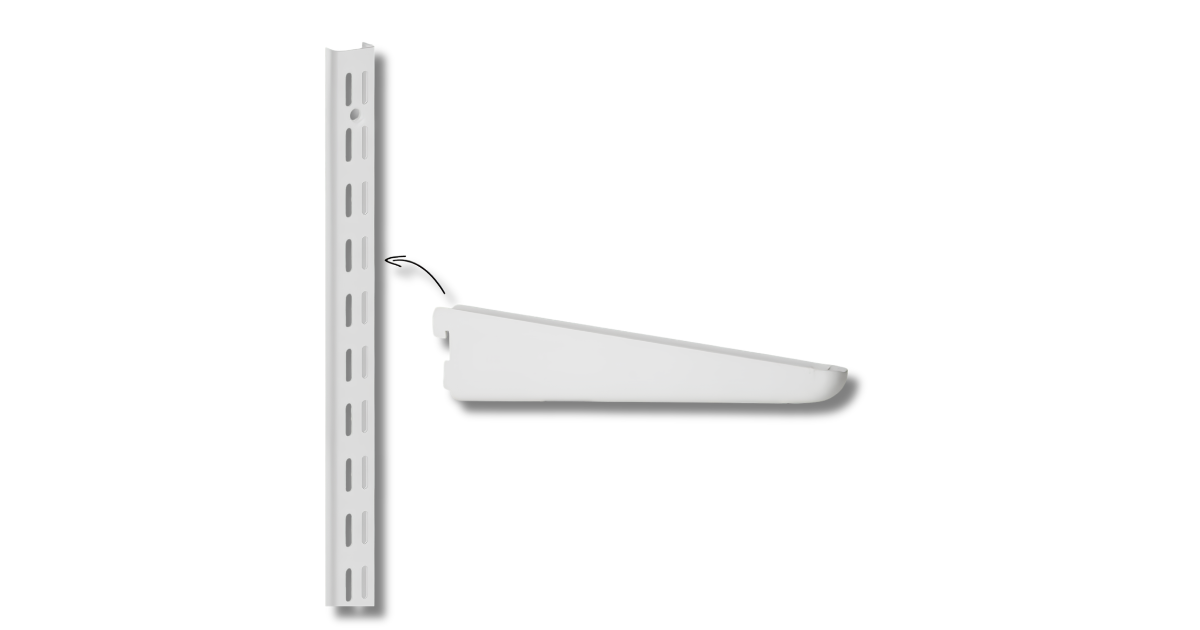
Wall shelf brackets carry a shelf out from the wall, and on an adjustable system they hook into a slotted upright rather than screwing into the wall themselves. That distinction decides everything that follows: which fixings the job needs, how far apart the supports sit, and what the finished run will actually hold. This guide covers choosing bracket length, setting spacing, fitting to different wall types, and what determines the load a run can take.
Two kinds of wall shelf bracket
Fixed brackets screw directly into the wall in pairs, one under each end of a shelf. They are simple, they suit a single shelf, and once the holes are drilled the height is permanent. Adding a second shelf later means drilling again and hoping the new run lines up with the old one.
Adjustable brackets work differently. A slotted upright, often called a wall band, is fixed vertically to the wall. Brackets hook into the slots at any height and can be lifted out and moved without touching the wall again. Two uprights carry as many shelves as needed, and the whole run can be reconfigured in minutes.
The trade is upfront work against later flexibility. Fixed brackets are quicker for one shelf. Adjustable systems win as soon as there is more than one shelf, or any chance the spacing will change. For storerooms, workshops, retail back-of-house and anywhere stock changes shape, adjustable is the sensible default.
How an adjustable system fits together
The shelf brackets supplied by Dreymar Industrial are part of a three-component wall band system. Understanding the three parts is what makes specifying it straightforward.
| Component | What it does | Available sizes |
|---|---|---|
| Double slot upright | Fixes vertically to the wall and carries the whole load into the structure | 1829 mm, 2134 mm, 2438 mm |
| Shelf bracket | Hooks into the upright slots and supports the shelf | 305 mm, 381 mm, 457 mm |
| Steel shelf | Sits across the brackets and holds the stock | 914 mm wide, 305 mm, 381 mm or 457 mm deep |
The uprights do the structural work. Brackets transfer load into them, and the wall fixings transfer it into the building. Nothing hangs off the brackets directly.
Choosing bracket length
Bracket length must match shelf depth. The three bracket lengths and the three shelf depths are the same figures for exactly that reason: a 381 mm bracket takes a 381 mm shelf.
A bracket shorter than the shelf leaves the front edge unsupported, which is where load concentrates when someone leans on it or slides an item off. A bracket longer than the shelf projects past the front edge, catching clothing and knuckles at head height and looking unfinished.
Choose the depth from the deepest item going on the shelf, then order brackets to match. At 305 mm the shelf takes files, boxed stock and packaged goods. At 457 mm it takes bulkier items and deeper stacking. Depth also decides how far the run intrudes into the room, which matters in a narrow storeroom or a corridor.
Bracket and upright spacing
On an adjustable system, horizontal spacing is set by the shelf rather than chosen freely. The steel shelf is 914 mm wide, so uprights are positioned to suit that span and runs are built in multiples of it. A 3 m wall takes three shelf widths at 2,742 mm, leaving 258 mm over.
Planning in shelf widths rather than metres avoids an awkward gap at the end of the run, and it means every shelf in the run is interchangeable. Trying to stretch spacing beyond the shelf width to save an upright is the most common mistake on this kind of installation. The shelf sags in the middle under load, and the sag does not recover.
Vertical spacing is where the adjustability earns its keep. Set shelf heights to the stock rather than at even intervals, and leave enough clearance above each shelf for a hand to lift items out rather than drag them. Because the brackets lift out of the slots, this can be corrected later, which is exactly what a fixed bracket cannot do.
Matching the installation to the wall
The wall, not the bracket, is almost always the limiting factor. A steel upright will outlast the fixings holding it up, so the substrate determines what the run can carry.
Brick and concrete
Solid masonry and concrete are the strongest substrates and the most straightforward. Uprights can generally be fixed anywhere along their length using fixings rated for the material. Avoid mortar joints where possible, since the joint is weaker than the brick either side of it. On older buildings, check whether the brick is solid or a cavity wall with a thin inner leaf, because the two behave very differently under load.
Plasterboard and drywall
Plasterboard on its own carries very little. For any loaded shelving run, uprights must be fixed into the timber or steel studs behind the board, not into the board itself. That means locating the studs first and setting upright positions to suit them, which sometimes means adjusting the planned run length.
Cavity fixings are designed for light fittings, not for storage. If the studs cannot be reached where the uprights need to go, the honest answer is that the wall is not suitable and a freestanding unit is the better solution.
Steel stud partitions
Common in offices and modern retail fit-outs. Studs are thin gauge steel and take specific fixings rather than woodscrews. Load capacity is lower than timber studs and much lower than masonry, so partition walls suit light display rather than stock storage.
When the wall is not the answer
Where the substrate is unknown, damaged, or clearly unsuitable, do not force it. Steel shelving stands on the floor and takes its load into the slab instead, which removes the question entirely and is usually the right call for heavy stock.
What determines load capacity
Capacity is not a property of the bracket alone. It is set by the weakest link in a chain, and the chain runs in this order.
- The wall fixings and the substrate they go into. Almost always the weakest point.
- The upright and how many fixing points secure it along its length.
- The bracket and how it engages with the slots.
- The shelf itself and how far it spans between supports.
Two runs built from identical components can hold very different loads depending on what they are fixed to. That is why a single figure per bracket tells you less than it appears to. Distribution matters too: weight spread evenly along a shelf behaves differently from the same weight concentrated at the front edge or in one corner.
For a specific configuration, confirm the rated load with Dreymar Industrial against the intended wall type, bracket length and shelf span rather than working from a general figure.
Fitting sequence
- Establish the run length and divide by the 914 mm shelf width to set upright positions.
- On stud walls, locate the studs first and adjust upright positions to suit them.
- Fix the first upright, checking it is truly vertical over its full height rather than only at the top.
- Use a level line across to the next upright position so slots align, otherwise every shelf in the run will sit slightly out.
- Fix remaining uprights, using every fixing point rather than the minimum that holds.
- Hook brackets in at the chosen heights and check they seat fully in the slots.
- Fit shelves and load progressively, starting low, checking nothing moves as weight goes on.
Slot alignment across uprights is the detail most often rushed. If the second upright sits a few millimetres higher than the first, every shelf tilts, and correcting it later means taking the whole run down.
Finishes
Brackets are available in white, black and hammertone grey, with custom colours on request. White and black suit visible runs where the fixture should either disappear or frame the stock. Hammertone grey is the practical choice for workshops and storerooms, since the textured finish hides marks and scuffs that show on a flat colour.
Match the bracket finish to the uprights and shelves across the whole run. Mixing finishes on a wall run is far more visible than it is on freestanding wall shelving assembled at different times.
Frequently asked questions
How do you fit wall shelf brackets?
On an adjustable system, fix the slotted uprights to the wall first, checking each is vertical and that slots align across the run. Hook the brackets into the slots at the chosen heights, seat them fully, then fit the shelves. The brackets themselves never fix to the wall directly.
How far apart should shelf brackets be spaced?
Spacing follows the shelf rather than being chosen freely. Dreymar Industrial steel shelves are 914 mm wide, so uprights are positioned to suit that span and runs are built in multiples of it. Stretching spacing beyond the shelf width causes the shelf to sag under load.
What length shelf bracket do I need?
Match bracket length to shelf depth. Brackets come in 305 mm, 381 mm and 457 mm, the same three figures as the shelf depths. A bracket shorter than the shelf leaves the front edge unsupported, and one longer than the shelf projects past the front and catches clothing.
How much weight can a shelf bracket hold?
Capacity is set by the weakest link, which is usually the wall fixings rather than the bracket. The substrate, the number of fixing points, the bracket length and the shelf span all change the answer. Confirm the rated load with Dreymar Industrial for the specific configuration and wall type.
Can shelf brackets be fitted to a plasterboard wall?
Only into the studs behind the board. Plasterboard alone carries very little, and cavity fixings are intended for light fittings rather than storage. Locate the studs first and set upright positions to suit. If the studs cannot be reached, a freestanding unit is the better solution.
What is the difference between fixed and adjustable shelf brackets?
Fixed brackets screw into the wall in pairs and set shelf height permanently. Adjustable brackets hook into a slotted upright and can be moved without touching the wall again. Adjustable systems suit multiple shelves and any situation where spacing may need to change later.