
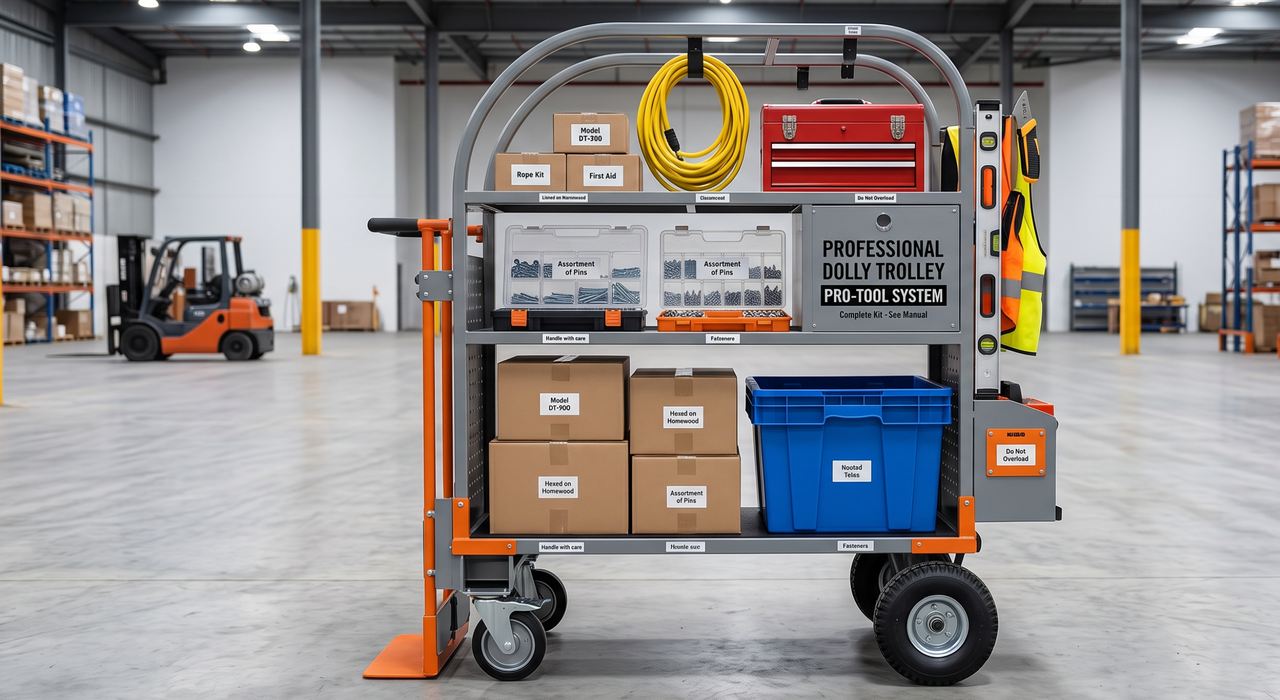
Trolley Dolly Explained: Definition, Types, and Everyday Uses in 2026
If you've ever tried to shift a stack of crates across a warehouse floor, or wrestle a bar fridge out of a delivery van, you've probably reached for something with wheels. But which one? A dolly? A trolley? A “trolley dolly”? The names blur together, and searching online only muddies things further because half the results are about handbags and airline crew.
Let's clear it up. In this guide, we'll explain what a trolley dolly actually is, how it differs from a standard trolley or hand truck, the main types you'll find on the South African market in 2026, and how to choose the right one for the load you're moving. Whether you're kitting out a stockroom, a food factory, or a distribution centre, by the end you'll know exactly what to ask for.
Key takeaways
- A trolley dolly is a flat, four-wheeled platform with no handles designed to move heavy or bulky loads by pushing directly on the deck, making it ideal for warehouses, factories, and stockrooms.
- The main difference between a dolly and a trolley is that a dolly has no handles and uses four swivel castors for 360-degree movement, while a trolley has a handle or push bar and mixed wheel types for more controlled steering.
- Choose a plastic trolley dolly for food production and hygienic environments, or a steel dolly for heavy industrial use, custom sizing, and long-term durability with replaceable parts.
- Always select a dolly with load capacity 50kg or more above your heaviest anticipated load to prevent early failure, and ensure the deck is large enough to centre the load across all four castors.
- A trolley dolly works best for single awkward items over short distances. For single-operator use over long distances, a handled platform trolley is more effective.
What is a trolley dolly? Definition and meaning
A trolley dolly is a flat, four-wheeled platform used to move heavy or bulky loads across a floor. It has no handles: the load sits centred on the deck and you push it directly. Swivel castors let it turn in tight spaces, making it standard equipment in warehouses, factories, hospitals, and stockrooms.
The term itself is a bit of a mash-up. “Dolly” is the older word for a low, wheeled platform. “Trolley” is the broader term for any wheeled cart used to move goods. Put them together and you get the informal phrase most South African buyers actually type into Google when they need a heavy-duty dolly trolley to shift crates, drums, or machinery.
One small note on spelling and jargon: some listings call it a “platform dolly,” others a “skate dolly,” and older workshop hands might just call it a “crate mover.” All the same beast.
Dolly and trolley: understanding the core concepts
Before we get into the differences, it helps to understand where each tool comes from and what problem it was built to solve.
A dolly is essentially a load-bearing platform on castors. It was designed for one job: getting a heavy object off the floor and onto rolling wheels so a person (or two) can push it without lifting. Nothing more. No handles, no shelves, no clever mechanisms. The simplicity is the point.
A trolley, on the other hand, is a broader family of wheeled equipment. It usually has some kind of handle or push bar so an operator can steer and control it while walking upright. The platform trolley you see in a stockroom, the two-wheeled hand trolley couriers use for boxes, and the flatbed trolley moving parcels around a depot all belong to that family.
So dolly and trolley aren't opposites. A dolly is one specific type of low-profile trolley, defined by what it doesn't have: handles. That single design choice changes how it's used, what it's used for, and who buys it.
Dolly vs trolley: key differences you should know
This is where the confusion usually sits. The two look similar in photos, but they're built for different jobs. Here's the clean version:
| Feature | Dolly | Trolley |
|---|---|---|
| Handles | None | Handle or push bar |
| Wheels | 4 swivel castors | 2 or 4 (mixed swivel/fixed) |
| Best load | Bulky, awkward, heavy | Stacked, regular, boxed |
| Operators | Often two | One |
| Loading | Lift onto the deck | Slide or tilt on |
| Typical use | Crates, drums, machinery, bins | Stock picking, parcels |
Design and structural distinctions
The headline difference is the handle. A trolley gives you leverage and steering from a standing position. A dolly gives you a clear, unobstructed deck. That matters more than it sounds. When you're moving a 200kg motor or a wide wooden crate, you don't want a handle in the way. You want to centre the load properly over the wheels so it doesn't tip.
Dollies also run on four swivel castors, all of them turning independently. That gives you full 360-degree movement in tight aisles but makes them harder to push in a straight line over long distances, which is exactly why trolleys with fixed rear wheels exist.
Load capacity and mobility comparison
A well-built industrial dolly typically carries anywhere from 150kg up to 500kg or more. Our standard model is rated at 400kg on an 800mm x 600mm steel platform, which covers the vast majority of warehouse loads [CONFIRM SPEC].
Trolleys vary more widely: a light-duty hand trolley might handle 150kg, while heavy platform trolleys reach 500kg or more. In practice, if your load is stackable and one person needs to walk it across a warehouse, choose a trolley. If it's a single heavy or oddly shaped object that needs two people to reposition, choose a dolly.
Common types of trolley dollies
Not every dolly is built for the same job. Here are the main types you'll come across in 2026:
- Platform (flat) dolly. The industrial standard. A flat steel or plastic deck on four swivel castors. This is the workhorse of warehouses, factories, and stockrooms.
- Furniture dolly. Usually a rectangular timber or carpeted deck, used by movers to slide couches, wardrobes, and appliances short distances.
- Appliance dolly. More of a hybrid, taller with straps, used to shift fridges and washing machines.
- Drum dolly. A round platform sized to cradle a 210-litre steel drum.
- Pallet dolly. A low-profile skate for moving loaded pallets short distances, though most sites use pallet jacks for anything further.
- Skate dolly. A small, very low-height version used to move machinery a few metres during installation.
Folding and collapsible trolley dollies
Folding models are aimed at users who need portability: couriers, event staff, or small business owners loading and unloading from a bakkie. They collapse flat for storage and typically use lighter frames with plastic decks. Capacity is lower, usually in the 60 to 90kg range. They're handy, but they're not built for sustained industrial use.
Heavy-duty and industrial models
Heavy-duty dollies are a different animal. Fabricated from steel, with reinforced frames, non-slip decks, and replaceable castors, they're designed to be pushed 40 to 50 times a day for years. They don't fold. They don't need to. In a food factory, a stockroom, or a manufacturing line, they live at a workstation and earn their keep every shift. This is the category the Dreymar platform dolly is built for.
Practical uses of a trolley dolly
The list of places a good dolly earns its money is longer than most people realise. A few of the most common:
- Warehousing and distribution. Moving crates, cages, and bulk bins between racking, packing benches, and dispatch. Often paired with a stock picking trolley for order fulfilment.
- Food and beverage production. Shifting stacked bread crates, bottle crates, and ingredient bins between production, cold storage, and dispatch. Plastic dollies dominate here because they're washable and food-safe.
- Manufacturing. Moving components, tooling, and part-finished goods between workstations without a forklift.
- Retail back-of-house. Unpacking deliveries and moving stock from the receiving bay to the shop floor.
- Hospitals and laundries. Transporting linen bags, waste bins, and equipment along smooth corridors.
- Print, packaging, and workshops. Moving reels, boxes of stock, and heavy tools between benches.
The common thread is that these are indoor, flat-floor environments where the load is too heavy to carry but doesn't need a forklift. That's the dolly's sweet spot.
How to choose the right trolley dolly for your needs
Rather than run through every spec sheet on the market, it's more useful to answer five practical questions. If you can answer these, you can walk into any supplier and ask for the right thing.
- What is the heaviest load you’ll move? Be honest, and add a margin. If your heaviest crate is 320kg, don't buy a 350kg-rated dolly. Go to 400kg or higher. Overloading is the number one reason dollies fail early.
- What shape and size is the load? Measure the footprint. The deck needs to be big enough that the load sits centred with weight distributed over all four castors. A load hanging off the edge will tip. The standard deck is 800mm x 600mm, but oddly shaped loads can be built to custom sizes.
- Who moves it, one person or two? A loaded four-castor dolly wanders. Over short distances that’s fine for one person. Over longer distances, or on any incline, plan for two. If the answer is always “one person over a long distance,” a handled platform trolley is the better tool.
- What is the floor surface? Smooth concrete or epoxy? Standard rubber or polyurethane castors are fine. Rough concrete, expansion joints, or the occasional pallet fragment? Go up in wheel size (125mm or 150mm) and choose a harder-wearing castor compound.
- Steel or plastic, what suits the environment? Plastic dollies are lighter, cheaper, food-safe, and easy to hose down. Ideal for bakeries, dairies, and beverage plants. Steel dollies handle heavier sustained loads, take custom sizing, and can be repaired rather than replaced. Ideal for warehousing, manufacturing, and heavy stockrooms.
Most trolleys/industrial-trolleys/dolly/" style="color:#1473e6;text-decoration:none;font-weight:500;">dolly trolleys sold in South Africa are injection-moulded plastic units built around a standard food-crate footprint. That's fine if you're moving food crates. If you're moving anything else, or anything heavier than about 250kg, a fabricated steel dolly trolley with custom sizing, a 12-month manufacturer’s warranty, and replaceable castors will serve you far better over its lifetime [CONFIRM SPEC]. That’s the gap the Dreymar range fills, alongside the wider trolleys catalogue.
Need an industrial dolly built for your loads?
Dreymar builds heavy-duty steel dollies rated to 400kg, with custom deck sizes, swivel castors and a 12-month warranty. Send us your load and we will spec the right unit.
View the industrial dolly range »The bottom line
A trolley dolly isn't a complicated piece of equipment, but choosing the right one makes a real difference to how efficiently a stockroom, warehouse, or factory runs. Remember the handles rule (dolly = no handles, trolley = handles), match the deck size and capacity honestly to your heaviest load, and pick the material that fits your environment. Get those three right and the tool disappears into the background, which is exactly what you want from good industrial equipment.
Frequently asked questions
What is a trolley dolly and how is it used?
A trolley dolly is a flat, four-wheeled platform with swivel castors used to move heavy or bulky loads. It has no handles: the load sits centred on the deck and you push it directly. It is standard equipment in warehouses, factories, hospitals, and stockrooms for shifting crates, drums, and machinery.
Is a dolly the same as a hand truck?
No. A hand truck (sometimes called a sack truck) is an upright, two-wheeled device with a small toe plate and a handle at the top. You tilt it back to move a load. A dolly is a flat, four-wheeled platform with no handles. Different tool, different job.
Do dollies have handles?
No. That is the defining feature. The absence of handles means the deck is unobstructed, so you can centre awkward or oversized loads properly. If it has a handle, it is a trolley, not a dolly.
What is the main difference between a dolly and a trolley?
The key difference is handles. A dolly has no handles and features a clear, unobstructed deck with four swivel castors, making it ideal for awkward or heavy single items. A trolley has a handle or push bar and mixed wheel types, making it better for stacked goods one person can control.
How much weight can a trolley dolly carry?
Industrial dollies typically carry 150kg to 500kg or more. A standard industrial dolly with an 800mm x 600mm steel platform is usually rated at 400kg, covering most warehouse loads. Always choose a capacity above your heaviest load to ensure safety and durability.
Can one person operate a trolley dolly?
Yes, over short distances on smooth floors. Because all four castors swivel, the dolly tends to wander, so two people is recommended for long distances or heavy loads. If a single operator needs to push across a full warehouse, a fixed-wheel handled trolley is a better choice.
What is the difference between a platform dolly and a furniture dolly?
A platform dolly is a general-purpose industrial deck, usually steel or heavy-duty plastic, sized for crates and drums. A furniture dolly is a lighter, often carpeted timber deck used to slide domestic furniture short distances without scratching it. One is built for daily use, the other for occasional use.
Should I buy a plastic or a steel dolly?
Plastic if you are moving food crates or need something washable, lightweight, and hygienic. Steel if you are moving heavier loads, need a custom deck size, or want a unit that can be repaired and re-castored for years of use. Match the material to the environment, not the price tag.
What are the common types of trolley dollies available?
The main types are platform (flat industrial deck), furniture (padded, for domestic items), appliance (taller, with straps for fridges), drum (for 210-litre drums), pallet (low-profile, for short-distance pallet movement), and skate (very low, for machinery installation).