
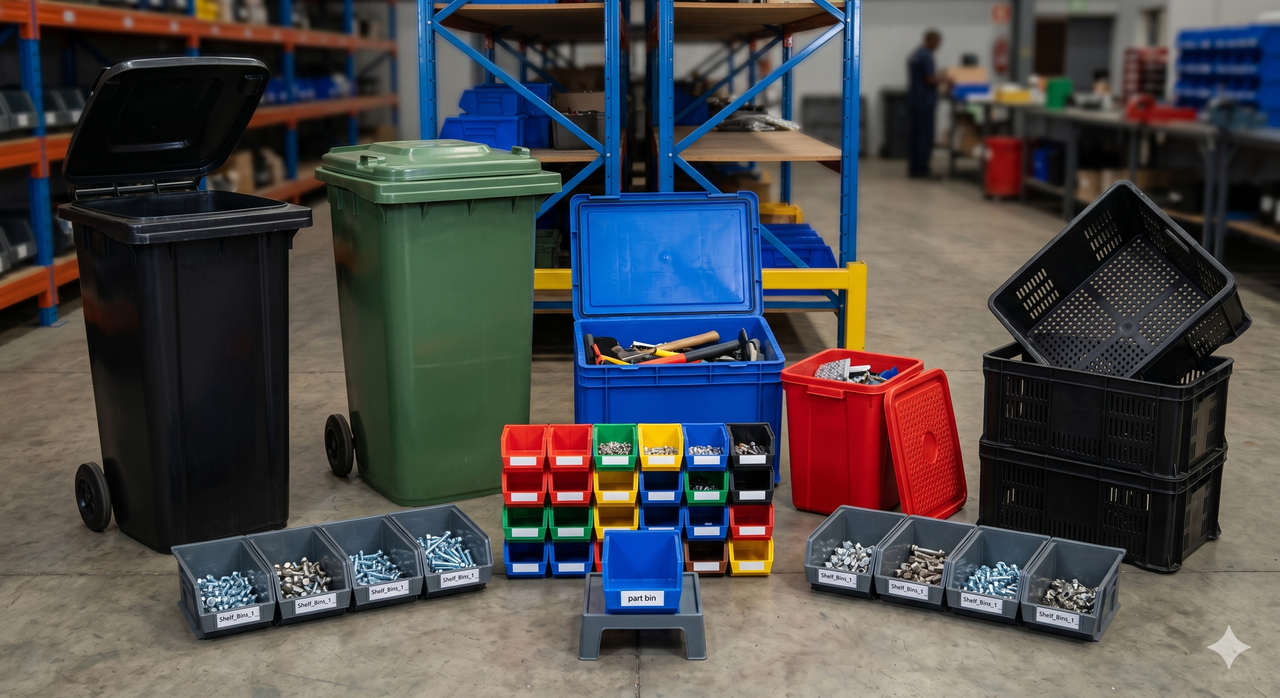
Bloemfontein is one of those places that’s quietly strategic. It doesn’t shout about it, but it sits right in the middle of a lot of South Africa’s movement. Trucks pass through. Stock gets staged. Warehouses support multiple provinces. And if your stores or dispatch area is messy, you feel it immediately.
So let’s talk about Bins.
Not as a “nice-to-have” for neat freaks. As a practical system that keeps factories, warehouses, hospitals, mines, hotel groups, and commercial property operations running clean and smooth. When your stock has a proper home, the site runs calmer. When it doesn’t, you get that familiar mess: missing parts, delayed jobs, and people walking around like they’re searching for a lost remote control.
Dreymar Industrial supplies industrial Bins for Bloemfontein buyers who need reliable storage, consistent supply, and bin systems that work in real industrial conditions.
Bloem’s superpower: central distribution (and the pressure that comes with it)
Here’s the thing. Central hubs don’t just store goods. They feed other sites.
So your bin system in Bloemfontein often needs to handle:
- higher stock movement (goods in, goods out, all day)
- faster picking (dispatch doesn’t wait)
- clearer stock control (because replenishment decisions affect other regions)
- mixed categories (maintenance spares, consumables, packaging, cleaning supplies)
And because many Bloem sites support multiple facilities, standardisation matters. Same bins, same labels, same logic. Less confusion, less rework.
What a good bin system does (beyond “storage”)
You know what? The real value of bins is operational.
A solid bin setup helps you:
- reduce picking time (people stop searching)
- improve stock accuracy (cycle counts become realistic)
- keep the floor cleaner (less clutter, fewer hazards)
- support hygiene routines (critical for FMCG and healthcare)
- make onboarding easier (new staff can follow the system)
It also helps with accountability. When there’s a clear home for each item, it’s harder for stock to drift into the shadows.
Choosing the right bins without making it complicated
Let me explain the simplest approach: match the bin type to how the item behaves.
Small parts and fast movers: Lin Bins
If your store holds nuts, bolts, fittings, connectors, bearings, seals, and all those small parts that vanish quickly, Lin Bins are usually the foundation.
They’re ideal for:
- maintenance stores
- workshops and technician cages
- production line replenishment
- spare parts rooms supporting mines and industrial sites
A quick aside: small parts cause big downtime. A missing R20 fitting can stop a machine that makes thousands per hour. Lin bins help prevent that silly kind of stoppage.
WIP, kitting, and movement: Tote Bins
If you’re staging orders, running kitting for maintenance jobs, or managing returns and rework, Tote Bins keep things contained and portable.
They work well for:
- building planned maintenance kits
- moving components between stations
- staging dispatch orders
- handling returns without clutter spreading
Totes also support repeatability. Same container, same label spot, same stacking. People learn it once and stick to it.
Quick-access shelving: Shelf Bins
For shelving-based stores where you want quick picking without pulling bins out constantly, Shelf Bins are a tidy solution.
They’re popular in:
- warehouse stores with frequent picks
- healthcare supply rooms
- hotel and facilities maintenance rooms
- commercial property operations (multiple buildings, mixed supplies)
Shelf bins help reduce “where does this go?” questions. The answer is visible.
Wall space that works harder: Linbin Panels
If your storeroom is short on floor space, but you’ve got walls going unused, Linbin Panels turn that dead space into organised storage.
Great for:
- workshops
- inspection stations
- technician bays
- consumables near the work area
It’s like putting your most-used items at arm’s length instead of sending people on a mini hike every time.
Waste management and hygiene control: Wheelie Bins
Waste is one of those quiet issues. When it’s handled well, nobody notices. When it’s handled badly, everyone notices.
Wheelie Bins support:
- packaging waste in FMCG
- general refuse for industrial sites
- controlled disposal areas for hospitals and hospitality
- yard and loading bay waste points
A clean waste system helps with pest control, slip risk, and audit readiness. That’s the real win.
Handling and stacking goods: Plastic Crates
If your team moves goods daily, not just stores them, Plastic Crates are the dependable workhorse.
Used for:
- inbound sorting
- dispatch staging
- stable stacking for heavier items
- back-of-house storage for hotels and facilities
Crates keep items contained. Contained items are easier to track. That’s the whole story.
“We already have bins” (and still, everything feels scattered)
This is common, especially in older stores.
A site might have some containers, some cartons, some random tubs, and a few proper bins. Technically, stock is stored. Practically, it’s chaos.
Here’s the mild contradiction: you don’t always need more bins, you need fewer types and better rules. Once you standardise your bin families and labels, the room starts behaving.
A simple system usually includes:
- consistent bin sizes (so shelving and stacking stays predictable)
- clear labels (SKU, description, min-max, location)
- replenishment rules (two-bin or min-max)
- a “returns lane” (so returns don’t infect the whole room)
Boring? Yes. Effective? Also yes.
Layout tips that work especially well in Bloemfontein
Because Bloem is often a hub, layout matters. You want flow.
A few practical moves:
- keep fast movers close to dispatch (less walking, quicker turnarounds)
- group items by task (electrical, mechanical, cleaning) not by supplier
- create a kitting zone using totes (stops kits being built on random shelves)
- use wall panels near benches for consumables (saves time in workshops)
- set up a quarantine or returns area (so dodgy stock doesn’t mix with good stock)
And if you manage multiple facilities, standardise the layout where possible. Staff transfers happen. Your stores shouldn’t feel like a brand-new puzzle every time.
Serving Bloemfontein and supporting multi-site supply
If you’re rolling out across multiple cities, Dreymar supports supply across major centres, including:
- Bins in Johannesburg for high-volume operations
- Bins in Pretoria for industrial parks and facilities-heavy sites
- Bins in Cape Town for logistics, FMCG, and hospitality groups
- Bins in Durban for KZN warehousing and port-linked supply chains
- Bins in Mbombela (Nelspruit) for regional operations and agricultural supply
- Bins in Gqeberha (Port Elizabeth) for Eastern Cape industry and manufacturing
- Bins in East London for warehousing and manufacturing support
- Bins in Pietermaritzburg for inland KZN facilities and stores
For national procurement and consistent spec reference, use Bins in South Africa as your main category page.
And if your footprint includes Limpopo and Gauteng nodes, you’ll likely also be planning for Bins in Polokwane and Bins in Centurion as part of a wider roll-out.
A quick spec checklist (so you can order cleanly)
Before you place your Bloemfontein order, answer these:
- What are you storing: small parts, bulk items, WIP, waste, or dispatch goods?
- How often is it handled: daily picks or occasional access?
- Where will it live: shelves, racks, walls, cages, trolleys?
- Do you need scanning: barcode, QR, or simple labels?
- Are you standardising across sites: yes or no?
Those five answers usually make the product selection obvious.
Ready to get the storeroom under control?
If your stores area is cluttered, slow, or inconsistent, don’t aim for perfect. Aim for repeatable.
Start with Bins in Bloemfontein and build a system that fits your workflow: Lin Bins for small parts, Tote Bins for kitting and movement, Shelf Bins for quick-access shelving, Linbin Panels for wall organisation, Wheelie Bins for waste control, and Plastic Crates for handling and stacking.
Because once the storage is sorted, everything else starts to feel lighter. And in a central hub like Bloemfontein, that kind of order pays you back every single day.