
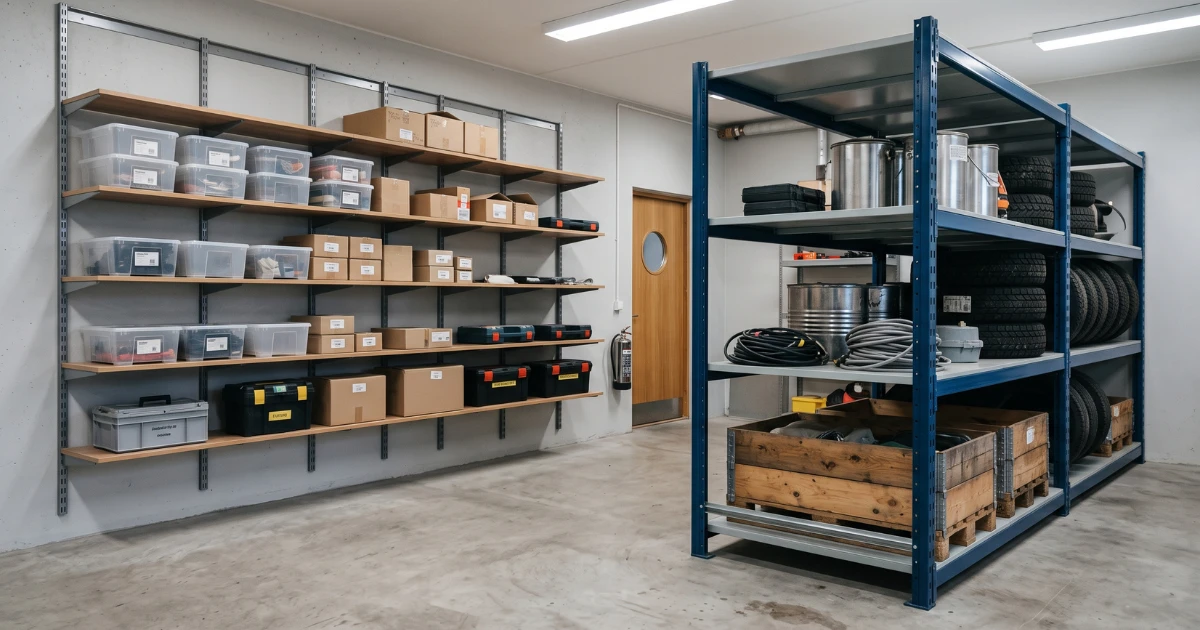
Choosing between wall band and traditional shelving comes down to two resources: wall space and floor space, and which one there is more of to work with. Wall band shelving transfers the load to a suitable wall and keeps the floor clear. Freestanding steel or boltless shelving stands on its own footprint and does not depend on the wall at all. Get the wall condition or the load wrong, either way, and the system underperforms.
Choosing shelving is not simply a matter of finding a shelf that fits an available wall. We also need to consider what the shelves will hold, how often the layout may change, whether the wall can support the system, and whether floor level access matters more than clear floor space. Those decisions determine whether wall band shelving or traditional, freestanding shelving is the more practical route.
Wall mounted shelving can make excellent use of vertical space in retail areas, storerooms, workshops and offices. Freestanding systems, including steel shelving and boltless shelving, may be more suitable where loads are heavier, walls are unsuitable, or the unit needs to move later. In this guide, we compare the two approaches and show how to assess the space, the wall and the workload before choosing.
01
Wall band shelving
Mounts to a suitable wall, keeps floor space clear
02
Freestanding shelving
Steel or boltless, stands independently on its own footprint
03
Wall condition
Masonry, concrete, timber or partition, fixing points must be dependable
04
Load per bay
Combined weight across all loaded shelves, not just the heaviest single shelf
On this page
Section 01
Wall Band Shelving vs Traditional Shelving: What's Actually Different
Wall band shelving is an adjustable storage system fixed to a wall, using vertical wall bands or uprights, shelf supports and shelves. It transfers much of its support to the building wall rather than to the floor, which is what makes it useful where wall space is available but floor space needs to remain clear. It combines the functionality of traditional shelving with the stability of wall-mounted supports, so shelves can be arranged at useful heights and the layout adapted as requirements change.
Traditional, freestanding shelving creates an independent storage bay that stands on the floor rather than relying on a wall. Steel shelving and boltless shelving are the common forms of this. Because the unit does not depend on a wall connection, it can be positioned away from a wall, used to divide a space, or moved when a room layout changes, and it is not limited by the condition or construction of a particular wall.
Neither is automatically the right answer for every room. Wall band shelving needs a wall that can provide suitable fixing points for the intended load. Freestanding shelving needs floor space it can occupy on its own footprint. The right choice comes down to which of those two things, wall or floor, we have more of to work with, and what the load actually requires.
Section 02
When Wall Band Shelving Is the Better Fit
Wall mounted shelving is often the better fit where a clear floor area matters more than a large footprint. It can be useful behind a counter, along a retail wall, in a storeroom with limited circulation space, or above a workbench. The system also suits changing display or storage needs, since shelves can be repositioned within the available adjustment points on the wall bands rather than requiring a new unit.
The components matter here. Double-slot uprights form the adjustable vertical structure, while wall band shelves provide the storage surface itself. The correct combination depends on the intended application and the wall dimensions, not simply on how much wall width is available.
Once wall band has been identified as the right direction, our shelf brackets range is the practical next step for reviewing the components that will carry the shelves. We should not select brackets before first considering the wall, the shelf dimensions and the expected use, since bracket position and spacing affect how evenly the load is carried. Detailed fitting steps belong in the dedicated guide, How to Choose and Fit Wall Shelf Brackets, which is the useful next read once wall band has been chosen and it's time to work through installation.
Action
Confirm the wall material and fixing points, then match double-slot uprights and wall band shelves to the wall dimensions and intended load, not just the available wall width.
Allow ten minutes
Section 03
When Traditional Shelving Is the Better Fit
Steel shelving or boltless shelving can make more sense when we need a floor-standing system for stock, tools, files or general warehouse storage. The key reason is independence from the wall: we can plan the unit around the floor layout rather than limiting the installation to whatever fixing points the wall happens to offer.
Freestanding shelving is also worth considering where stored goods are bulky, where shelves need a deeper footprint, or where a unit may need to be relocated later. In a warehouse or workshop, the ability to reorganise bays can outweigh the floor-saving advantage that a wall-mounted system offers.
Our steel shelving range is the more relevant route once the decision is moving towards freestanding storage. Where the requirement is part of a larger warehouse or factory storage plan rather than a single wall or room, our broader guide to industrial shelving covers that scale of decision.
Action
If goods are bulky, heavier, or the unit may need to move later, plan the freestanding footprint on the floor layout before ordering steel or boltless shelving.
Allow five minutes
Section 04
Load Capacity, Wall Type, and Floor Space: What Actually Decides It
The wall, the fixing points and the intended load should be assessed together before choosing wall band shelving. A wall-mounted system is not supported by the shelf alone, its performance depends on the substrate, the fixings, and how the load is distributed across the shelves. We should identify what the wall is made from and whether it offers dependable fixing points. Masonry, concrete, timber and partitioned construction all present different practical conditions.
Load per shelf and load per bay are not the same question. A shelf carrying a few evenly distributed items presents a different demand from one carrying a concentrated load in the centre, and a bay with several loaded shelves puts more combined weight on the wall connection than any single shelf does on its own. We should size the system to the bay's total load, not just the heaviest individual shelf.
If the wall material or condition is uncertain, resolve that before selecting a wall-mounted layout at all. Wall space and floor space should be measured separately rather than assumed. Usable wall area can be interrupted by doors, windows, services or fittings, while a freestanding unit needs a clear footprint on the floor instead. If the wall cannot offer confidence on any of these points, a freestanding alternative is usually the more reliable route, not a fallback.
Action
Identify the wall material, confirm dependable fixing points, and size the system to the bay's total load, not just the heaviest single shelf.
Allow ten minutes
Section 05
Quick Decision Checklist
Before choosing, run through a short checklist:
- Is there a wall with dependable fixing points, or does the load need to sit on the floor instead?
- Will the layout need to change often, or is a fixed arrangement good enough?
- What does each shelf need to carry, not just the total stock across the whole bay?
- Is floor space or wall space the scarcer resource in this particular room?
Section 06
The Practical Takeaway
The decision comes down to four things: the wall, the load, the available space and the likelihood of future change. Wall band shelving is a strong option when a suitable wall is available, floor space matters, and adjustable wall mounted shelves will improve the layout. Freestanding steel or boltless shelving is usually the more practical route when the wall cannot be relied on, the goods are heavier or bulkier, or the unit needs to move independently of the building. Assess those conditions before choosing components, and the right system follows from there. Where the requirement spans several storage types rather than a single wall or bay, our wider racking and shelving range is the place to look next.
Get these four right
- Wall band shelving optimises vertical wall space while keeping floor areas clear, making it ideal for retail, offices, and workshops where floor access is essential.
- Choosing wall band shelving requires careful assessment of the wall's material and strength to ensure safe and reliable fixing points for adjustable shelves.
- Freestanding shelving systems like steel or boltless shelving suit heavier loads, bulkier items, and situations where shelving needs to be relocated or placed independently of walls.
- Plan shelving layouts based on the size, weight, and frequency of access of stored items, ensuring shelf spacing allows safe and practical handling.
Answers
Frequently Asked Questions
Is wall band shelving as strong as traditional steel shelving?
Strength depends on the wall and the specific components used, not on the category alone. A well-fixed wall band system on a suitable wall can carry a substantial load, but a freestanding steel unit is not limited by wall condition at all, which is why heavier or bulkier loads usually suit freestanding shelving better.
Can I use wall band shelving if I'm not sure about my wall type?
Not until that's confirmed. Wall band shelving depends on the wall providing dependable fixing points, so an uncertain or unsuitable wall is a reason to resolve that first, or to consider freestanding shelving instead of guessing.
Can wall band and freestanding steel shelving be used together in the same space?
Yes. Many workshops, storerooms and retail areas combine both, using wall band shelving where wall space is available and freestanding units where floor space and larger loads make more sense. The two are not mutually exclusive.
Which takes up less space, wall band or traditional shelving?
Wall band shelving generally keeps more floor area clear, since it uses wall height instead of a floor footprint. Freestanding shelving needs its own footprint but does not depend on wall space at all, so the better use of space depends on which one, wall or floor, is scarcer in that room.
Not sure whether your wall can carry wall band shelving, or whether you need a freestanding unit instead?
Tell us your wall type, the load you need to carry, and how much floor space you have, and we will help you match it to the right system.