
Centurion is one of those “in-between” places that’s actually a power move. Close to Pretoria. Quick access to Johannesburg. Packed with business parks, warehouses, distribution centres, and facilities teams that have to keep things moving without making a noise about it.
And when the pace is that steady, storage can’t be sloppy.
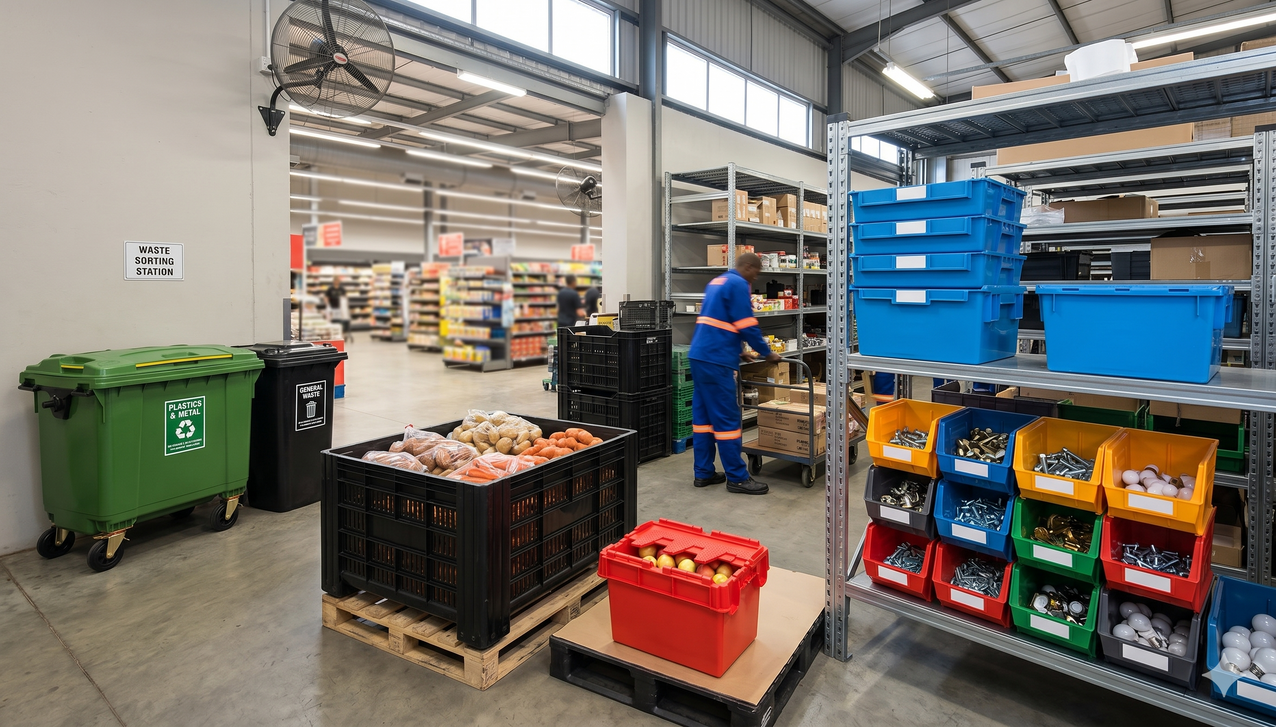
That’s where Bins come in. Not as plastic containers, but as a simple control system. If stock has a clear home, people stop wasting time. If people stop wasting time, everything feels calmer, even on busy days.
Dreymar Industrial supplies industrial Bins to buyers in Centurion who support factories, warehouses, mines, hospitals, hotel groups, and commercial property operations. Whether you’re cleaning up a stores room, setting up a new dispatch area, or standardising supply across Gauteng, the goal is the same: tidy storage that stays tidy.
Centurion’s pace: fast enough to hurt, steady enough to fix
Here’s the thing. In Centurion, many operations sit in that sweet spot between corporate and industrial. You’ve got formal procurement processes, but you also have real-world pressure from ops. Dispatch wants speed. Maintenance wants availability. Facilities wants cleanliness. Finance wants cost control. Everyone wants everything.
So a good bin system has to tick a few boxes:
- quick access (less searching)
- repeatable layout (so people don’t “invent” new systems)
- cleanable surfaces (especially for FMCG, healthcare, and hospitality)
- stable stacking (no toppling towers)
- consistent supply (so you can add to the system later)
It’s not a big ask. It just needs the right bin families and a bit of discipline.
What a proper bin system gives you (besides a neat storeroom)
You know what? Bins are one of the cheapest ways to improve operational flow.
A well-planned bin setup helps you:
- reduce picking and issuing time
- improve stock accuracy and cycle counts
- support lean stores and 5S housekeeping
- reduce clutter and trip hazards
- make audits and inspections less stressful
And for multi-site buyers, it helps with standardisation. Same bins, same labels, same logic across locations. That’s a quiet win.
Choosing the right bins for Centurion sites (the no-drama version)
Let me explain it simply: match the bin to the job.
Small parts and spares: Lin Bins
If you store fasteners, fittings, electrical components, bearings, seals, or spares that get issued constantly, Lin Bins are usually the starting point.
They’re perfect for:
- maintenance stores
- technician cages
- workshop spares
- production replenishment zones
A quick aside: “small parts” are where downtime starts. Not big motors. The tiny stuff. Lin bins help you keep the tiny stuff visible and available.
Kitting, WIP, and internal movement: Tote Bins
For building kits, moving items between stations, staging dispatch orders, or handling returns, Tote Bins keep things together and easy to move.
They work well in:
- FMCG packaging and component staging
- dispatch consolidation lanes
- maintenance shutdown preparation
- returns and rework areas
Totes also support consistency. Same bin, same label position, same stacking. Less chance for chaos to creep in.
Shelving-based picking: Shelf Bins
If you’ve got shelving and frequent picks, Shelf Bins make it easy to grab items without pulling bins out all day.
They’re common in:
- storerooms with high pick rates
- healthcare supply rooms
- hotel maintenance stores
- commercial property facilities teams
Shelf bins are also a training tool. New staff can follow the layout without guesswork.
Wall storage for quick reach: Linbin Panels
Some Centurion workshops and facilities rooms are short on floor space. Walls, though? Plenty.
Linbin Panels are great for:
- technician bays
- workshops and benches
- inspection points
- consumables close to the job
It’s like putting the “always-used” stuff at arm’s length. People stop walking back and forth for basic items.
Waste handling and site hygiene: Wheelie Bins
Waste is a big deal in business parks and industrial sites, especially where multiple tenants and facilities teams operate. Overflow and mess create complaints fast.
Wheelie Bins support:
- packaging waste in FMCG and warehousing
- general refuse for industrial operations
- controlled waste points in hospitals and hospitality
- yard and loading bay waste stations
Clean waste control is one of those “boring” things that makes a site look professionally run.
Handling and stacking goods: Plastic Crates
If your team moves goods daily, Plastic Crates are a dependable way to stack, transport, and stage stock.
Often used for:
- inbound sorting
- dispatch staging
- stable stacking for heavier items
- back-of-house storage in hospitality and facilities
Crates are basically the work boots of storage. Not pretty, but they keep showing up.
“We already have bins” (and yet stock still goes missing)
This is the classic situation.
A storeroom might have containers, cartons, tubs, and a few proper bins. Technically, stock is stored. Practically, it drifts. It gets mixed. It becomes “that one shelf” nobody wants to touch.
Here’s the mild contradiction: you don’t necessarily need more bins. You need fewer types and better rules.
A good bin system usually includes:
- consistent bin families and sizes
- clear labels (SKU, description, min-max)
- fixed locations (so items don’t migrate)
- simple replenishment rules (two-bin or min-max)
- a returns or quarantine lane (so messy stock doesn’t infect the system)
Once those are in place, the storeroom starts running itself.
Layout ideas that work well in Centurion operations
Because Centurion sites often serve multiple departments, layout should support flow.
A few practical moves:
- keep fast movers near issuing or dispatch
- group items by task (electrical, mechanical, cleaning) not by supplier
- create a kitting zone using totes (stops kits being built everywhere)
- use wall panels near benches for consumables
- keep a dedicated returns area (returns are where systems go to die)
And if you manage multiple sites, standardise the layout as much as you can. Staff transfers happen. Your stores shouldn’t feel like a new maze every time.
Supporting Centurion, and linking to supply across SA
Many buyers in Centurion manage supply across multiple locations. Dreymar supports major centres, including:
- Bins in Johannesburg for high-volume operations and DCs
- Bins in Pretoria for nearby industrial parks and facility-heavy sites
- Bins in Cape Town for logistics, FMCG, and hospitality groups
- Bins in Durban for KZN warehousing and port-linked supply chains
- Bins in Mbombela (Nelspruit) for regional operations and agricultural supply
- Bins in Gqeberha (Port Elizabeth) for Eastern Cape industry support
- Bins in Bloemfontein for central distribution
- Bins in East London for warehousing and manufacturing support
- Bins in Pietermaritzburg for inland KZN facilities
For national reference and consistent spec across regions, use Bins in South Africa as your category anchor.
And if your footprint includes Limpopo, many procurement teams pair Centurion supply planning with Bins in Polokwane too.
A quick spec checklist (so you can order once, not three times)
Before placing an order, answer these five questions:
- What are you storing: small parts, bulk items, WIP, waste, or dispatch goods?
- How often is it handled: daily picks or occasional access?
- Where will it live: shelves, racks, walls, cages, trolleys?
- Do you need labels or scanning: barcode, QR, or simple visual tags?
- Are you standardising across sites: yes or no?
If you can answer that, you can spec the right bin system quickly.
Ready to tidy up without slowing the operation?
If your storeroom is cluttered, slow, or inconsistent, don’t aim for perfect. Aim for repeatable. That’s what works in the real world.
Start with Bins in Centurion supply planning, then build with proven categories: Lin Bins for small parts, Tote Bins for kitting and movement, Shelf Bins for quick-access shelving, Linbin Panels for wall organisation, Wheelie Bins for waste control, and Plastic Crates for handling and stacking.
Because when your storage is sorted, people move faster, mistakes drop, and the whole site just feels better run. In Centurion, that calm efficiency is the real flex.